Frida Kahlo
Kahlo painted small oils on Masonite and on sheets of metal (tin, aluminum, zinc and copper), and larger ones on canvas. Her biographer describes her early method on aluminum: an undercoat, an outline in pencil or ink, then paint laid from the upper left corner across and down, "completing each area as she went along." Later she blocked in broad areas of color first and then brought the image up "section by section". Infrared photographs of three later Masonite panels show an underdrawing in thin lines and wide ink strokes that fixed the composition; details changed in the paint.
The paint box
Painted here
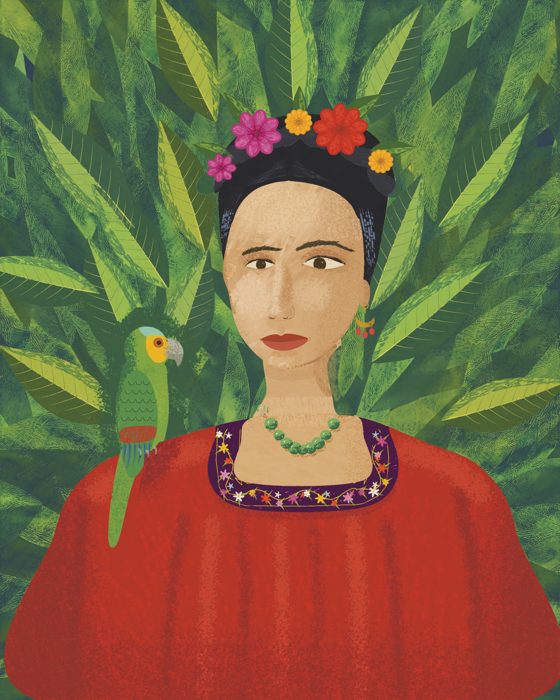
Materials and method
A sourced technical report. Every claim cites a source key; the sources are listed at the end. "Uncertain" marks claims that are unverified, disputed or taken from a single object. The laboratory evidence is thin. It comes from one published study of samples taken from a single large canvas of 1939, read in full, and one museum conservator's account of three oils on Masonite examined with infrared photography and X-rays, also read in full. Most of the rest comes from two books by her biographer and a book on her still lifes, read through Internet Archive full-text search excerpts (page numbers not recovered), and from museum collection records. The early working method in §7 was pieced together from overlapping excerpts of one passage. The studio in the Casa Azul was read through museum and magazine descriptions and four visitors' photographs of its display; one magazine description and one museum record were read only through search summaries.
Summary
Kahlo painted small oils on Masonite and on sheets of metal (tin, aluminum, zinc and copper), and larger ones on canvas [HER83; HER91; DMA; GRIM; MOMA; ACS]. Her biographer describes her early method on aluminum: an undercoat, an outline in pencil or ink, then paint laid from the upper left corner across and down, "completing each area as she went along." Later she blocked in broad areas of color first and then brought the image up "section by section" [HER83]. Infrared photographs of three later Masonite panels show an underdrawing in thin lines and wide ink strokes that fixed the composition; details changed in the paint [DMA]. She worked with "very small sable brushes" in delicate strokes [HER83; HER91]. On the one analyzed canvas the paint is direct, one to three layers, in linseed oil, laid on a cotton canvas without a ground [ACS]. The pigments proposed there from the elements found are listed in §4. Late works show looser brushwork and gritty impasto [HER83]. No varnish of hers is documented.
Terms. Ground/priming: the preparatory layers between support and paint. Size: a thin glue layer sealing a fabric. Masonite: a hardboard of pressed wood fiber. Retablo, ex-voto: a small Mexican devotional painting, traditionally on a sheet of tin. Tondo: a round painting. Underdrawing: drawing on the support under the paint. Infrared (IR) photography: imaging that shows carbon-based drawing under paint. X-radiograph: an image made with X-rays, which shows lead-rich and other dense paint. Cross-section: a microscopic sample cut through all layers. SEM-EDS: electron microscopy that reports the chemical elements in a sample, not the compounds, so pigments are inferred from them. Fillers: inert white powders a maker adds to tube paint. Lithopone: a white of zinc sulfide and barium sulfate. Metal soaps: compounds that form when metal ions from a pigment react with the fatty acids of the oil. Impasto: thick, raised paint. Pentimento: an earlier, changed passage under the visible paint.
1. Supports
- Small. "The majority of her paintings are small—twelve by fifteen inches is not unusual" [HER83]. Her biographer writes of "her small sheets of Masonite or tin," on which she "zeroed in on herself" [HER91].
- Masonite. The three paintings examined in Dallas (1944, 1947 and 1951) are oil on Masonite [DMA]. So are portraits of 1929 to 1937 and a still life of 1938, 40.6 × 60 cm [GRIM]. A compiled listing of about 146 oils puts 55 on Masonite, the first in 1929 [WLIST]. Approximate; a compiled list.
- Sheet metal, from 1932. A hospital scene of 1932 "is the first painting in which Frida used sheet metal as its support." Her husband, a muralist, had suggested that she "try, like a retablo painter, to paint on tin panels" [HER91]. A friend recalled shopping with her for sheet metal on a Detroit street, in "one of those old musty-looking stores in a poor neighborhood" [HER83]. The biographer's account of her first metal panels calls them "sheet aluminum" [HER83]. Read through search excerpts; that this passage refers to 1932 is inferred from its context.
- Later metal supports. A self-portrait of 1938 is on "a fine sheet of scratched aluminium," 28.5 × 20.7 cm [POMP]. A still life of 1938 is on aluminum [MMOCA]; the still-lifes book gives tin for the same work [GRIM]. A family-tree painting of 1936 is "oil and tempera on zinc," 30.7 × 34.5 cm [MOMA] (read through search excerpts). Still lifes of 1937–38 are on tin, about 20 × 25 cm, and a self-portrait miniature of 1938 is an oval on tin, 12 × 7 cm [GRIM]. The listing counts 27 oils on metal [WLIST].
- Copper tondos. Two round still lifes of 1941 and 1942 "are the same size and cut from copper sheets," 64.5 cm across, and were meant as pendants [GRIM]. A New York review of 1938 called her pictures "mostly painted in oil on copper," with "the daintiness of miniatures" [HER83, quoting the review]. A reviewer's impression; the record shows Masonite and other metals more often.
- Canvas. Her early oils (1924–30) are mostly on canvas, a few on wood [WLIST]. A double portrait of 1931 is oil on canvas, 100.1 × 78.7 cm [SFM]. The large canvas of 1939 was her "first large-format canvas": a "medium-weave cotton canvas," 173.5 cm square, the width of the textile roll, probably a commercial cotton stretched on "the very light wooden frame with movable joints" and interior cross braces [ACS]. Some canvases were later mounted on board [WLIST].
- Frames. She set a self-portrait on aluminum behind a reverse-painted glass frame bought in a Oaxaca market [POMP; GAC-FRAME]. A double portrait of 1944 keeps its original painted shell frame, a Veracruz souvenir frame whose inscription was covered with red paint, "probably by Frida herself" [DMA].
2. Grounds
- Canvas without a ground. On the canvas of 1939, "most of the microsamples have a lack of preparation ground"; the weave can be seen through the paint at the edge. One sample suggests a light hide-glue size and a red paint layer [ACS]. Without a seal the cotton absorbed the linseed oil, which wicked through to the back of the canvas [ACS].
- Metal: an undercoat. She prepared her small aluminum panels "with an undercoating to form a binder between metal and pigment" [HER83]. Its composition is not given. Read through search excerpts.
3. Drawing and lay-in
- Studies on paper. Pencil drawings precede some paintings: in 1932, days after a miscarriage, "she took up a pencil and drew" studies of a fetus [HER83]. A sketch for the family-tree painting of 1936 and a study of about 1937 in pencil and colored pencil on tracing paper survive [HER91]. Read through caption excerpts.
- Outline on the support. On her early metal panels she began by "drawing the general outlines of her image in pencil or ink" [HER83].
- Underdrawing seen in infrared. On a still life of 1951 IR shows "an initial planning drawing done in both thin lines and wide ink strokes." Between drawing and paint she simplified the fruits, shifting their size and shape. "The most labored part of the underdrawing shows several adjustments" to a bird's wing and beak and changes to the mango beside it [DMA]. In a painting of 1947 "the basic composition was generally set from the underdrawing to the early painting phase." Across the three panels the underdrawing showed "a strong vision for the overall composition" [DMA].
- No general lay-in at first. She finished each area in turn rather than "loosely brushing in color areas and gradually refining the image." In later years she did "block in broad areas of color" first [HER83].
4. Pigments
One painting has published pigment evidence: the canvas of 1939, sampled at ten points in 2008 (six of them whites) and examined by microscopy and SEM-EDS [ACS]. The authors propose "a possible color palette" from the elements found, and most identifications are hedged [ACS]. No flesh passage was sampled.
| Pigment | Evidence | Notes |
|---|---|---|
| Zinc white | Zinc-rich white layers, alternating with lead white, in seven of ten samples [ACS] | With aluminosilicate and calcium carbonate fillers "typical of commercial paints"; she probably mixed the tube zinc white with her colors [ACS] |
| Lead white | Lead-rich white layers, "sometimes applied as touches of light," many without fillers [ACS] | Alternates with zinc white layer by layer [ACS] |
| Vermilion | Mercury and sulfur in one red layer, mixed with zinc white [ACS] | One sample, under a later purple [ACS] |
| Cadmium red | Cadmium and selenium in the reds of a heart and its arteries, "possibly prepared with cadmium red" [ACS] | Mixed with iron oxide reds, zinc white and barite or lithopone [ACS] |
| Red iron oxide | Iron with the cadmium red [ACS] | Natural or synthetic not stated |
| Chrome yellow | Chromium and lead in yellow layers: "suggests chrome yellow" [ACS] | |
| Ochre | Iron in the same yellow layers "may be related to an ochre" [ACS] | |
| Cerulean blue | Cobalt and tin in a light blue sky, "possibly obtained with cerulean blue," mixed with zinc and lead whites [ACS] | |
| Ultramarine | Aluminosilicates in blue and purple-blue layers "could be related to ultramarine blue or other fillers" [ACS] | Uncertain: the same elements are read elsewhere as fillers |
| Earth pigments, iron oxides | Iron with zinc in a gray of clouds and a brown ground [ACS] | Kind not stated |
| Carbon black | "Some carbon black was observed" in the dark regions [ACS] | Kind not stated |
| Organic purple | A purple layer with silicon, aluminum and zinc white but no inorganic violet; "may indicate the use of an organic pigment" [ACS] | Unidentified |
| Cadmium yellow | "Tubes of cadmium yellow crusted at the caps" in the studio display [SLM] | Uncertain: one visitor's description, read through a summary; not found by analysis |
- Two of one color. The samples show "her frequent choice of using two pigments of the same color to obtain nuanced tones": two whites, and at least three reds [ACS].
- Period paints. The palette "aligns with those employed by her contemporaries between 1930 and 1940 and with materials manufactured in the 1940s" [ACS]. Fillers in most layers point to commercial tube paint [ACS].
- Fillers. Aluminosilicates, calcium carbonate, and barite or lithopone [ACS]. Lead in the red layers "may be related to red or white lead pigment" [ACS].
- Metallic powder. In an early portrait of a poet friend (1927) she used "a type of gold paint (known in Mexico as 'purpurina,' or a metallic bronze powder)" for a star, a harp, a halo and details of a skull [TLAX].
- The studio display. Visitors' photographs of the Casa Azul studio show a wooden paint box, its lid crusted with paint, full of used, rolled-up tubes whose labels cannot be read; glass bottles of powdered color; jars of glitter and metallic flakes; a mortar and pestle; brushes in jars; and a wooden palette [PHOTO]. Her palette and brushes lie on her worktable [HER83]; her brushes were shown in a display drawn from the archive [TRU]. Whether every item is hers, and from when, is not recorded.
- A diary color key. Her diary gives meanings for colors, among them "Cobalt blue: electricity and purity. Love" [TIB]. These are color words, not a record of paints.
5. Media and varnish
- Linseed oil. NMR of a sample from the canvas of 1939 found linseed oil, "almost completely dry" [ACS].
- Tube paint. The fillers point to commercial oil paints [ACS]. Her first oils came from her father's paint box: "I stoled [sic] from my father some oil paints" [HER83; GRIM].
- Oil and tempera. The family-tree painting of 1936 combines oil and tempera on zinc [MOMA; HER83 caption]. Which passages are tempera is not recorded.
- Bronze powder in an early oil (§4) [TLAX].
- Paint on her clothes. Examiners found "many traces of pigment on the skirts upon which Kahlo rested her palette and brushes," stained with red paint and splashes of blue and black ink [GAC-POS]; some of her garments are "flecked with paint" [VAM].
- Varnish. On the self-portrait in the glass frame, "the varnish has deteriorated," uncovering more of the portrait once hidden under the painted flowers [GAC-FRAME]. The source does not say whose varnish or on which part.
6. Layers and application
- Direct. The cross-sections show "a very direct stratigraphy": most have one to three layers "that reflect the color on the surface" [ACS].
- Mixtures. The sky is cerulean mixed with zinc and lead whites; the gray of the clouds is zinc white with an iron pigment and perhaps carbon; the red of the heart is probably cadmium red with iron red and zinc white [ACS]. Paler tints use zinc or lead white, sometimes both; pure lead white supplies "touches of light" [ACS].
- Small brushes. "With very small sable brushes, which she kept immaculately clean, she would carefully lay down delicate strokes of color, bringing the image into precise focus" [HER83]. "With fine sable brushes, she set down her image stroke by tiny stroke" [HER91]. When she was a girl her father, a photographer, taught her to use "fine-pointed brushes to retouch and color photographs" [HER91].
- Varied strokes. "Small rapid brushstrokes" give "intricately varied textures and color" in a still life of 1951; "long, sinuous strokes" dominate a painting of 1947; a small double portrait of 1944 has "highly textured paint applied in short, tiny strokes" [DMA].
- Fingerprints. "Impressions of Frida's fingerprints are visible in the paint" of two of the three Dallas panels [DMA].
- Portraits and self-portraits. Most of her roughly two hundred paintings were self-portraits [HER83]. After her accident her mother had a special easel made and "placed a mirror along the entire ceiling so I could see myself and use my image as a model" [GAC-MFK]. "As her proficiency grew, her realism became more meticulous in terms of texture and modeling" [HER83]. In a portrait of 1944 she gave "unusually close attention to specific textures," "building up the image with heavy layers of pigment, and painting each detail with a different touch." The biographer likens "the woolliness" of the sitter's sweater and shawl to "the hairy texture of the flowering" plant in the picture [HER83] (the end of the sentence was not recovered). A museum commentary on the double portrait of 1931 notes how she "very carefully and delicately modulates the blues" of a shirt [SFM]. Single accounts.
- Texture with flecks. In the 1927 portrait she put "flecks of gray and white paint on some of the darker areas to give his coat the appearance of a woollen texture" [TLAX].
- Late impasto. In the last years "brushwork becomes looser; she has lost the exquisite precision of the miniaturist." In one late picture "brushwork is messy; impasto is gritty; color is murky"; another was "painted in a slapdash way with thick impasto" [HER83]. Her biographer links this to pain and "larger and larger doses of drugs" [HER83].
7. Working sequence and reworking
- The early metal-panel method. After the undercoat and the outline (§2–3), "she would proceed as if she were painting a fresco rather than an oil," then, "starting in the upper left corner, working with slow, patient concentration across and from the top downward, completing each area as she went along." Her biographer calls it "almost a coloring-book approach," but effective [HER83]. Reassembled from search excerpts of one passage; its date, about 1932, is inferred from context.
- Later. "In later years, she would block in broad areas of color before bringing the image, section by section, to a high degree of verisimilitude" [HER83].
- Details evolve in the paint. In the painting of 1947, plant pods around a sun "largely began closed but opened gradually during the painting process," and a new element emerged as she finished; the composition itself stayed as drawn [DMA].
- Speed and changes on the large canvas. She "worked at a rapid pace" on the canvas of 1939, and photographs show it in progress [ACS]. A photograph of about September 1939 shows a heart further to the right than in the finished picture. A color photograph of 1939 shows a purple skirt that she soon repainted white, which left "poor adhesion between the two layers of paint." She "meticulously overpainted the composition and made several changes and adjustments with different white pigments" [ACS].
- Later reworking. On a still life of 1938 she changed a skeleton's smile to a frown in 1939 [MMOCA]. When a still life was returned to her, she painted over the recipient's name, left the dedication and sold it [GRIM]. Single accounts.
- Lying down. Her mother "ordered a special easel so that Frida could paint lying down" [HER91]. Her later studio has an easel made for artists with limited mobility, a patron's gift [MFK].
8. Condition and aging
- Cracks and losses in the whites. The canvas of 1939 shows "pronounced fine cracking and localized areas of paint loss and surface erosion," worst in the white skirt and other white regions [ACS].
- Causes proposed. The repainted skirt adheres poorly. The canvas had "insufficient preparation" and moves. The oil wicked into and through the unprimed cotton, noted already in early conservation reports with craquelure [ACS].
- Zinc soaps and zinc lactate. Zinc soaps grew from the zinc white and may alter how the white absorbs light; zinc lactate runs through several layers, not only the surface. The authors propose that radicals from the drying linseed oil, with zinc oxide as catalyst, degraded the cotton [ACS]. Zinc white in oil is linked elsewhere to "brittle films that are prone to cracking" [ACS].
- Fluorescence. Under UV the whites glow differently, greenish in the skirt and blue in the ruffles; the authors relate this to the different whites and to the form of the zinc white particles [ACS].
- Treatment and residues. The samples hold "a common restoration resin" from a past treatment and residues of the pesticide DDT [ACS].
- A lost glass border. On the framed self-portrait much of the reverse-painted floral border has gone, uncovering more of the portrait [GAC-FRAME].
9. The tubes here
The historical names in this note are mapped to these tubes: zinc white → zinc white; lead white → lead white; vermilion → vermilion; cadmium red → cadmium red; red iron oxide → red earth (a proxy: natural or synthetic is not stated); chrome yellow → chrome yellow; ochre → yellow ochre; cerulean → cerulean blue; ultramarine → ultramarine blue; earth pigments and iron oxides (the browns) → brown ochre (a proxy); carbon black → bone black (a proxy: the kind of black is not stated); the unidentified organic purple → magenta (a proxy, inference: an aniline lake on alumina is one organic purple of the period, and nothing identifies hers); the studio's cadmium yellow → cadmium yellow. Ultramarine, the purple and cadmium yellow rest on weak evidence (§4).
10. At this easel
- Support. Plain-weave linen with ground layers laid from the tubes.
- Paint. Pigment from the tubes with an oil-medium share.
- Taking paint off. A brush picks up wet paint as it passes; that is how paint comes off the canvas.
- Everything else the easel does is in the easel guide.
Sources
- [ACS] Aguilar-Rodríguez, P., Zetina, S., Mejía-González, A. and Esturau-Escofet, N., "Characterization by Spectroscopic and Microscopic Techniques of Degraded Zinc White Pigment in Las Dos Fridas," ACS Omega 10:16 (2025), pp.16309–16318, doi 10.1021/acsomega.4c10530. Ten microsamples of the canvas of 1939 (Museo de Arte Moderno, Mexico City) taken in 2008 for the national conservation center and reanalyzed. Full text read; cited by section. https://pmc.ncbi.nlm.nih.gov/articles/PMC12044470/
- [DMA] Hartman, L. E., "Conserving Kahlo," Uncrated (Dallas Museum of Art blog), 29 March 2021: IR photography, X-radiography and microscopy of three oils on Masonite (1944, 1947, 1951). Full text read. https://blog.dma.org/2021/03/29/conserving-kahlo/
- [HER83] Herrera, H., Frida: A Biography of Frida Kahlo (New York: Harper & Row, 1983). Read through Internet Archive full-text search excerpts; page numbers not recovered. The introduction was read in full in a classroom excerpt (http://msmcdonaghsclass.weebly.com/uploads/6/8/7/5/68751153/fromfridaabiographyoffridakahlo.pdf). Quotes the 1938 New York review. https://archive.org/details/fridabiographyof00herr
- [HER91] Herrera, H., Frida Kahlo: The Paintings (New York: HarperCollins, 1991). Read through Internet Archive full-text search excerpts, including captions; page numbers not recovered. https://archive.org/details/fridakahlopainti00herr
- [GRIM] Grimberg, S., Frida Kahlo: The Still Lifes (London: Merrell, 2008). Read through Internet Archive full-text search excerpts, mostly captions. https://archive.org/details/fridakahlostilll0000grim
- [TIB] Tibol, R., Frida Kahlo: An Open Life (Albuquerque: University of New Mexico Press, 1993), quoting the diary's color key. Read through an Internet Archive full-text search excerpt. https://archive.org/details/fridakahloopenli0000tibo_p3k4
- [POMP] Pierron, S., "Focus on… 'The Frame' by Frida Kahlo," Centre Pompidou magazine, 10 November 2020 (modified 2023): oil on aluminum, 1938, 28.5 × 20.7 cm. Read through a page summary. https://www.centrepompidou.fr/en/pompidou-plus/magazine/article/focus-on-the-frame-by-frida-kahlo
- [GAC-FRAME] Centre Pompidou, "The Frame by Frida Kahlo," Google Arts & Culture story. Read through a page summary. https://artsandculture.google.com/story/the-frame-by-frida-kahlo-the-centre-pompidou/jwXxfGRb93QdIA
- [MMOCA] Madison Museum of Contemporary Art, collection record for a still life of 1938 (Pitahayas), oil on aluminum. Read through a page summary. https://www.mmoca.org/artwork/pitahayas-frida-kahlo/
- [MOMA] Museum of Modern Art, New York, collection record for a painting of 1936: oil and tempera on zinc, 30.7 × 34.5 cm. Read through search excerpts; the page refused automated access. https://www.moma.org/collection/works/78784
- [SFM] San Francisco Museum of Modern Art, collection record 36.6061, a double portrait of 1931: oil on canvas, 100.1 × 78.7 cm, with audio commentary. Read through a page summary. https://www.sfmoma.org/artwork/36.6061/
- [GAC-MFK] Museo Frida Kahlo, "Frida Kahlo: A Painter by Accident," Google Arts & Culture story, quoting her on her father's paint box, the easel and the mirror. Read through a page summary. https://artsandculture.google.com/story/frida-kahlo-a-painter-by-accident-museo-frida-kahlo/aQXx_7rTlD2JoA
- [GAC-POS] Google Arts & Culture, "An Insight into Frida Kahlo through Her Most Personal Possessions." Read through a page summary. https://artsandculture.google.com/story/an-insight-into-frida-kahlo-through-her-most-personal-possessions/ngWxMni_K733JQ
- [TLAX] Instituto Tlaxcalteca de la Cultura, "The Early Work of Frida Kahlo," Google Arts & Culture story, on two early oils and her watercolors. Read through a page summary. https://artsandculture.google.com/story/the-early-work-of-frida-kahlo-instituto-tlaxcalteca-de-la-cultura/xQXxFe0aE0y3KQ
- [MFK] Museo Frida Kahlo, "Museum" page (the easel; the 2004 finds). Read through a page summary. https://www.museofridakahlo.org.mx/museo/?lang=en
- [TRU] Trujillo, H., text on the Casa Azul archive and its exhibitions (Spanish Ministry of Culture PDF), with the archive inventory figures and a display that included her brushes. Full text read. https://www.cultura.gob.es/dam/jcr:bf38e4dc-5d2c-4661-9d2a-7106ee7a539c/exposiciones-tesoros-casa-azul-h-trujillo.pdf
- [VAM] Victoria and Albert Museum, "Unlocking Frida Kahlo's wardrobe." Read through a page summary. https://www.vam.ac.uk/articles/unlocking-frida-kahlos-wardrobe
- [SLM] "Frida Kahlo Blue House Mexico: A Time Capsule," Social Life Magazine, 1 December 2025, a visitor's description of the studio. Read through a page summary. https://sociallifemagazine.com/art/frida-kahlo-blue-house-mexico-casa-azul-guide/
- [PHOTO] Four visitors' photographs of the Casa Azul studio display, published on a personal blog in 2013 and viewed for this note: https://images.squarespace-cdn.com/content/v1/5fe0dc1e84919756fc786580/1612349870026-67609UMSADGQJMY28GEZ/box-paint-tubes-inside-frida-kahlo-studio.jpg ; https://images.squarespace-cdn.com/content/v1/5fe0dc1e84919756fc786580/1612349869550-C2SX9XMFK3556C7DANJO/paints-Frida-Kahlo-art-studio-mexico-city.jpg ; https://images.squarespace-cdn.com/content/v1/5fe0dc1e84919756fc786580/1612349888098-VYLJ6FC6BKP4AJBZRIL3/paints-brushes-palette-frida-kahlo.jpg ; https://images.squarespace-cdn.com/content/v1/5fe0dc1e84919756fc786580/1612349868520-NQNHA47TGYKY7ZTVJSAT/inside-frida-kahlo-studio-desk.jpg
- [WLIST] Wikipedia, "List of paintings by Frida Kahlo," supports as listed, counted 2 October 2026 (about 146 oils: 57 on canvas, some mounted on board; 55 on Masonite; 27 on metal; 7 on wood). A compiled secondary list. https://en.wikipedia.org/wiki/List_of_paintings_by_Frida_Kahlo