Pablo Picasso
Picasso painted mostly on ready-primed linen; in Barcelona in 1917 he used cotton. Grounds are white, of lead white in oil or glue, with one grey ground in 1925. In his early years he often painted over earlier pictures without a new ground. In 1907 and 1932 he laid compositions in with the brush, not pencil, and left the ground showing between passages. His colors came from artists' tubes throughout; from 1912 he also used Ripolin, a ready-mixed enamel house paint, alone or mixed with tube colors.
The paint box
Painted here
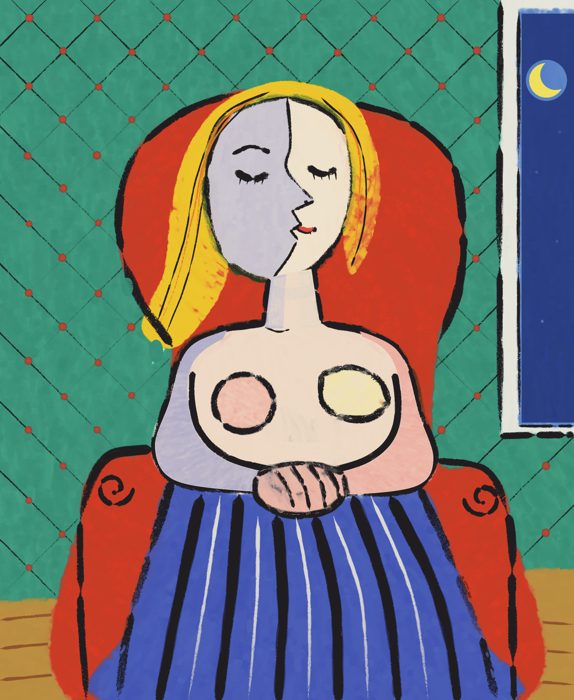
Sleeping Woman in a Red Armchair
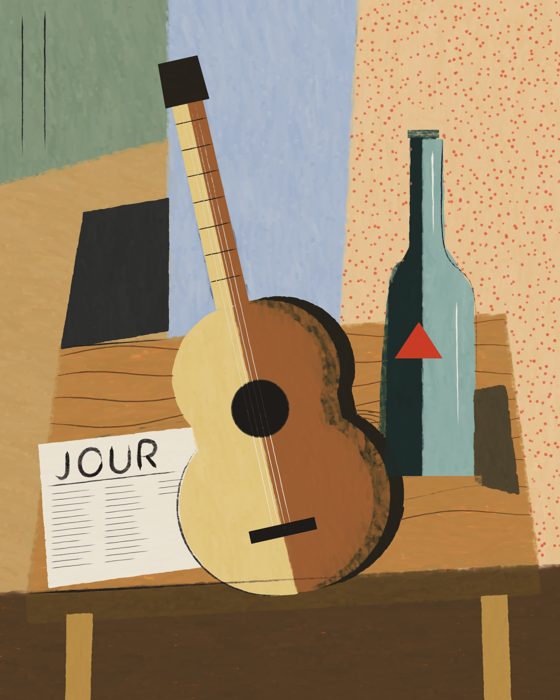
Guitare, bouteille et journal (Guitar, Bottle and Newspaper)
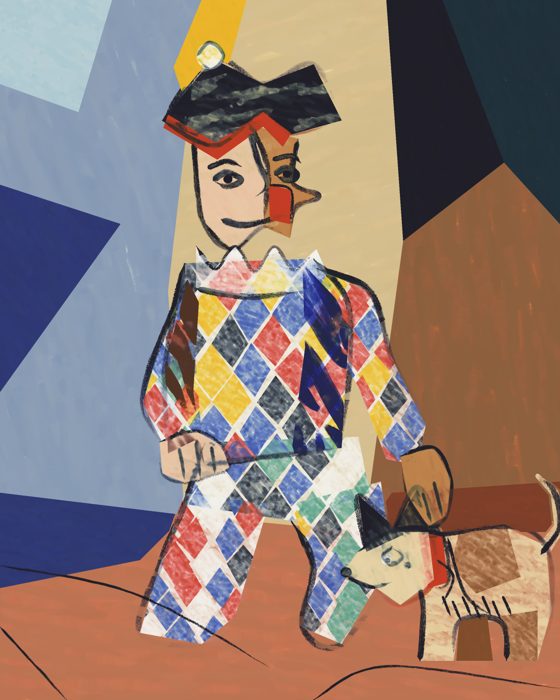
Harlequin with His Dog
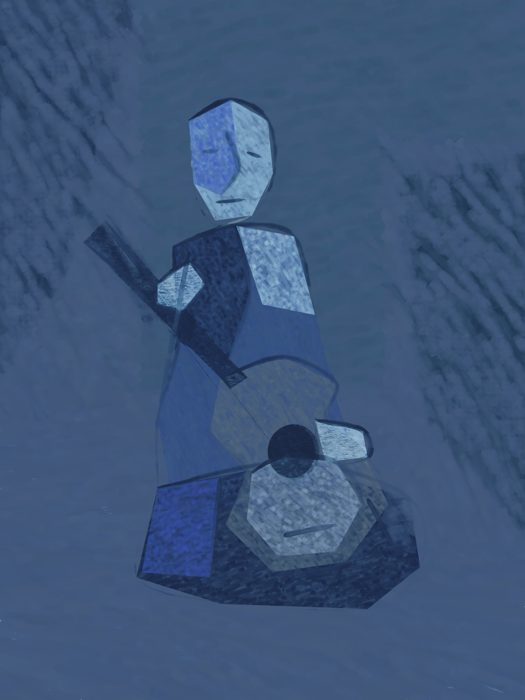
The Blue Guitarist
Materials and method
A sourced technical report. Every claim cites a source key; the sources are listed at the end. "Uncertain" marks claims that are unverified, disputed or taken from a single object. Each claim names its period: early work (to 1900), Blue Period (1901–04), Rose Period (1905–06), Cubism (1907–17), the 1920s–30s and later work (1940s–73). The evidence is museum studies of single paintings, the Art Institute of Chicago's work on the house paint Ripolin, and a few witnesses. The Tate studies, those of canvases of 1901, 1903 and 1917, a study of Ripolin's binder and a sitter's memoir were read in full; the Museum of Modern Art's report on a canvas of 1907 through Internet Archive copies of its website. The Chicago Ripolin studies and those from the Metropolitan Museum, Antibes and the Menil Collection were read only through abstracts, a museum article and press accounts; a study of a canvas of 1902 through a project page and search summaries. The simulator holds only artists' pigments in oil; §4 and §9 say what that leaves out.
Summary
Picasso painted mostly on ready-primed linen; in Barcelona in 1917 he used cotton [TATE-GC; TATE-TD; TATE-NW; MPB17]. Grounds are white, of lead white in oil or glue, with one grey ground in 1925 [PHIL; SOLER; TATE-NW; TATE-TD; MPB17]. In his early years he often painted over earlier pictures without a new ground [PHIL; MPB-EP; NU-MIS; TATE-GC]. In 1907 and 1932 he laid compositions in with the brush, not pencil, and left the ground showing between passages [MOMA-D; TATE-NW]. His colors came from artists' tubes throughout; from 1912 he also used Ripolin, a ready-mixed enamel house paint, alone or mixed with tube colors [AIC-CAN; AIC-RIP; SOLER]. The Blue Period palette is built on Prussian blue and zinc white [PHIL]; later palettes add cobalt blue, emerald green, cadmium yellow, iron oxides and vermilion [MOMA-D; MPB17; TATE-TD; TATE-NW]. Early paint is thinned with turpentine, scraped and rubbed down [TATE-GC]; in 1925 and 1932 it is laid fast, wet in wet, with thick accents [TATE-TD; TATE-NW]. Two examined canvases have no original varnish [TATE-GC; TATE-TD]. The pigments are listed in §4.
Terms. Ground/priming: the layers between canvas and paint. Ready-primed: primed by the maker. Standard sizes: the French series of canvas sizes, numbered with a letter for the format ("20 F"). Strainer: a stretcher with fixed corners. Grisaille: a painting in greys. XRF: X-ray fluorescence, which names the elements in paint. IRR: infrared imaging, which shows carbon drawing under paint. X-radiograph: an X-ray image, which shows lead-rich paint. Enamel paint: a ready-mixed house paint that dries to a glossy, level film. Heat-bodied oil: linseed oil thickened by heating. Wet-in-wet: paint laid into wet paint. Impasto: thick, raised paint. Lining: a second canvas glued to the back. Metal soaps: compounds formed when metal ions from a pigment react with the oil.
1. Supports
- Ready-primed linen. A canvas of about 1904–05 is very fine plain-weave linen, 25 by 27 threads per cm, primed before stretching [TATE-GC]. The canvas of 1925 is middle-weight linen, 17 by 18 threads per cm, primed before stretching [TATE-TD]. The canvas of 1907 and its oil study are linen with a white ground [MOMA-D "Studies"].
- Standard sizes. The canvas of about 1904–05 is on a standard "20 F" stretcher (73 × 60 cm), that of 1932 on a "60 F" strainer of the series colormen supplied [TATE-GC; TATE-NW]. In June and July 1932 he ordered seventy-three canvases, with strainers in sizes 25 to 100 [TATE-NW].
- Cotton in 1917. In Barcelona, without a studio, he bought all his materials locally; the four canvases examined are cotton [MPB17].
- Formats. From 50.5 × 61.6 cm (1901) [PHIL] to 150 × 200 cm (1903) [SOLER], 243.9 × 233.7 cm (1907) [MOMA-D] and 215.3 × 142.2 cm (1925) [TATE-TD]; in Chicago, 130.7 × 97.2 cm (1954) and 194 × 279.5 cm (1959) [AIC-API].
- Reused canvases. Six portraits of 1895–1901 all cover earlier compositions [MPB-EP]. A canvas of 1901 covers a finished portrait of his own [PHIL]; one of 1902 covers another Barcelona painter's landscape, turned 90 degrees [NU-MIS]; the canvas of about 1904–05 covers a boy and an earlier, scraped image [TATE-GC]. A conservator said that "about half" the paintings in a 1997 show of his early work "have something underneath to investigate" [AP97]. In 1917 he "did not re-use any canvas (as he commonly did)" [MPB17]. At Antibes in 1946 he used re-used canvases, fibrocement, wood panels and paper [ANT].
- Panels. The Chicago picture of 1931 identified with Ripolin is "oil and Ripolin on panel" [AIC-API]. One of 1938 has sand glued to a panel [MENIL].
- Rolled and lined. The 1907 canvas was rolled, paint side in, on his studio moves and glue-lined, probably in 1924 [MOMA-D "1907", "1924"].
2. Grounds
- Lead white. In 1901 the ground is "commercially prepared ... lead white with gypsum filler" [PHIL]; in 1903, oil with lead white, calcite and barite [SOLER]. About 1904–05 there are two off-white layers of lead white in oil; the upper, warmer one may be his own over a commercial priming [TATE-GC]. Uncertain. In 1932 a single layer of lead white in oil is typical of "a commercially prepared French colourmaker's canvas" [TATE-NW].
- Glue grounds, 1907 and 1917. By the Museum of Modern Art's account, his canvases of about 1907 were sized with rabbit-skin glue and coated with lead, chalk and glue; a companion recalled that he favored "fine tight canvas with a very smooth grain, less absorbent than others" [MOMA-D "Canvas Preparation"]. In 1917 all four canvases have two ground layers, mainly animal glue with a little oil; the upper one is lead white with calcite on three, a zinc compound on one, grey to orange in tone [MPB17].
- Grey in 1925. A commercial grey ground of lead white and bone black in oil over thick glue size [TATE-TD].
- Ground left showing. He left priming bare where planes meet in 1907 [MOMA-D "Executing"], at the center of the 1925 picture ("a conscious choice") [TATE-TD], and between color passages in 1932 [TATE-NW].
- No new ground over old pictures. The 1901 picture went straight over the earlier portrait, "without applying an intermediate ground layer" [PHIL].
3. Drawing and lay-in
- Charcoal or graphite, 1903. The family group of 1903 was drawn on the primed canvas, and the paint follows the drawing [SOLER].
- Paint, not pencil, 1907 and 1932. After many drawings and a watercolor, he "laid the composition in with oil paint" on the 1907 canvas, with no pencil or charcoal underdrawing, outlining areas in dark paint and filling them with parallel strokes of a loaded brush [MOMA-D "Studies", "Executing"]. In 1932 the outlines are thin, dry, brushed dark grey or black; he "seems to have planned and executed his composition entirely with paint" [TATE-NW]. Tate's curators note that "as a rule Picasso did not make preparatory drawings for his paintings" [TATE-NW n.11]; 1907 is an exception [MOMA-D].
- A grisaille start. The canvas of 1925 began about 1923 as black outlines on the grey ground, filled out with white [TATE-TD].
- Charcoal in wet paint. In 1932 grey outlines hold charcoal-like grains caught in wet paint, laid with a fairly dry brush [TATE-NW]. At Antibes in 1946 he drew "immediately in the wet paint, a quick line in graphite or charcoal that blackened and dug out its trail," sometimes incising with the brush handle, and made greys of white and crushed charcoal [TATE-NW nn.12–13, quoting the Antibes catalogue].
4. Pigments
Each pigment is listed with the dates of the objects where analysis found it.
| Pigment | Evidence | Notes |
|---|---|---|
| Lead white | Grounds 1901, 1903 [PHIL; SOLER]; paint 1895–1901 [MPB-EP], 1902 [MIS20], 1907 [MOMA-D], 1913 [SOLER], 1917 [MPB17], 1922 [AIC-RIP], 1925 [TATE-TD], 1932 [TATE-NW] | None in the 1901 surface picture [PHIL]; none in Ripolin [SOLER] |
| Zinc white, with barium sulfate | "The primary white" of 1901 [PHIL]; impasto about 1904–05 (UV, inference) [TATE-GC]; 1912–13 [SOLER]; 1925 [TATE-TD]; 1932 highlights [TATE-NW]; 1946 [KOK] | Ripolin's white is nearly pure zinc oxide [ANL] |
| Prussian blue | Main blue 1901, 1902, 1903 [PHIL; NU-MIS; SOLER]; 1895–1901 [MPB-EP]; about 1904–05 [TATE-GC]; 1913 [SOLER]; 1925, and a signature of 1964 [TATE-TD] | In 1901 always mixed with a trace of vermilion, probably by the maker [PHIL] |
| Ultramarine | 1901, one small sea only [PHIL]; 1902 [NU-MIS]; 1903, 1913 [SOLER]; about 1904–05 [TATE-GC]; 1917, the main blue [MPB17]; 1925 [TATE-TD] | Synthetic is inferred from the dates |
| Cobalt blue | 1895–1901 [MPB-EP]; 1907 [MOMA-D] | |
| Cerulean blue | About 1904–05, "probably" [TATE-GC] | Uncertain; one object |
| Viridian | 1901 [PHIL]; 1903, 1913 [SOLER]; 1917 [MPB17]; 1932 [TATE-NW] | |
| Emerald green | 1901 [PHIL]; 1907 [MOMA-D]; 1932 [TATE-NW] | |
| Chrome yellow | 1901, two shades, one paler and sulfate-rich [PHIL]; 1902 [NU-MIS]; 1903, 1913 [SOLER] | |
| Strontium yellow | 1917, one canvas [MPB17] | A pale chromate yellow |
| Cadmium yellow | 1901 [PHIL]; 1903 [SOLER]; 1907 [MOMA-D]; 1932 [TATE-NW] | |
| Vermilion | 1895–1901 [MPB-EP]; 1901, the only red [PHIL]; 1903 [SOLER]; 1904–05 [TATE-GC]; 1907 [MOMA-D]; 1917 [MPB17]; 1922 [AIC-RIP]; 1925 [TATE-TD] | Pinks of 1901 are vermilion and zinc white, "rather than the more expected use of a lake pigment" [PHIL] |
| Mars red | About 1904–05 [TATE-GC]; 1917, "such as Mars red" [MPB17] | |
| Red iron oxide | 1903, reddish browns [SOLER] | Natural or synthetic not stated |
| Mars yellow, Mars orange | 1925, browns [TATE-TD] | |
| Yellow and brown earths | 1895–1901 [MPB-EP]; about 1904–05 [TATE-GC]; 1907 browns [MOMA-D]; 1917 beiges [MPB17] | Kinds not specified |
| Bone or ivory black | 1901 [PHIL]; 1902 (inferred) [MIS20]; 1895–1901 [MPB-EP]; 1907 [MOMA-D]; 1917 [MPB17]; 1925 [TATE-TD] | |
| Carbon black, charcoal | 1932 (inferred); 1946 [TATE-NW] | Worked into wet paint |
| Cobalt violet | 1932, with zinc white [TATE-NW] | Single object |
- Ripolin. A French ready-mixed enamel house paint, sold from 1897, named for its inventor and lin, linseed oil [KOK; AIC-CAN]. Its binder is heat-bodied linseed oil with pine resin [KOK]; its white is nearly pure zinc oxide [ANL]. It dried "into a hard, glossy enamel in hours, unmarred by the marks of the brush, but prone to ... wrinkling and dripping" [AIC-CAN].
- His use of it. In 1912 he wrote of his Ripolin pictures: "Perhaps we will manage to shock and disgust the whole world" [AIC-CAN]; Ripolin is identified in a picture of 1912 [SOLER, citing the Antibes catalogue]. A sitter quoted him: "They are ... la santé des couleurs" [STEIN p.173]. He used it to the end, with tube paints [AIC-CAN].
- Where it is found. In the 1931 panel: "Ripolin Blanc de neige, used alone and mixed with artist's tube colors" [AIC-RIP]. Not in a still life of 1922 (vermilion, lead white and barium sulfate) [AIC-RIP], the 1913 repainting [SOLER] or the canvas of 1925, which is tube paint [TATE-TD]. Four Metropolitan paintings with enamel-like surfaces showed "traditional artist's materials" and no definite marker of house paint [MET]. At Antibes he used several white enamels in turn, not Ripolin alone [ANT; KOK].
5. Media and varnish
- Oil thinned with turpentine. About 1904–05 the paint was thinned "to such a degree that it only just forms a coherent paint film," for a matte look like gouache [TATE-GC]. The 1907 medium is oil [MOMA-D "Technical Analysis"].
- Tube oils, 1917 and 1925. In 1917 browns and reds are in linseed oil, whites in poppy or safflower and sunflower oils [MPB17]. In 1925 a white is in poppy oil, and paint of lead white with chalk, barytes and magnesium carbonate suggests a London colorman's tubes [TATE-TD].
- Altered media. The Metropolitan's study stresses "his manipulation and alteration of the oil medium" [MET]. In 1938 he worked tube paints "to achieve the handling properties he desired" beside non-artists' paints [MENIL].
- Matte against gloss. In 1925 "the play of matte and gloss paint is important" [TATE-TD]. In 1931 Ripolin and oil run from a rough yellow background to "the almost brushless finish of the black lines" [AIC-API].
- No varnish. No overall varnish on the canvases of about 1904–05 and 1925 [TATE-GC; TATE-TD], none between the two pictures of 1901 [PHIL]. The coatings on the 1907 canvas are the museum's (1950, 1963) [MOMA-D]. He wanted the 1925 canvas framed in nothing more than a thin batten [TATE-TD].
6. Layers and application
- Blue Period: thin, mixed on the palette. In 1901 layers are 3.5 to over 25 µm thick, with "no highly pastose regions." The surface picture is in evenly blended mixtures, Prussian blue and zinc white in many proportions; the portrait under it is mixed more wet-into-wet [PHIL]. A friend recalled: "the palette was on the floor. White, heaped in the center, constituted the basis of that type of mixture, which he prepared especially with blue" [PHIL].
- Scraped and scored, about 1904–05. He scraped layers down to the thread tops, laid thin washes, scored soft flesh paint with a rounded tool, and dragged dry strokes over the thread tops so lower colors show; thin paint was let run down the background [TATE-GC].
- A small palette, 1905–06. A sitter saw him paint from "a very small palette which was of a uniform brown grey colour" [STEIN p.57].
- Thin to thick, 1907. "From thin scumbles to heavy applications of impastoed paint"; in reworked heads the paint is "so thick that the artist could dig into it with the stem of his brush" [MOMA-D].
- Flat, 1917. Uniform areas of color, thin, in one or few layers [MPB17].
- Swirled, 1925. The last painting was "executed rapidly," its impasto laid wet-in-wet, "picking up and swirling neighbouring colours"; lines are incised [TATE-TD].
- Islands of color, 1932. Most of the figure is "one flat, thin, fast-drying layer" of adjacent islands that meet without overlapping. Thick accents follow: a bead made with one twist of a loaded brush, white and black marbled wet-in-wet, an eyebrow scraped into wet paint [TATE-NW].
- Enamel handling, 1938. Colors swirl like marbled paper with sharp boundaries, the later ones laid while the earlier were still fluid [MENIL]. When a friend remarked in 1953 on the drips in his chapel murals, he said: "You don't tell someone miserable to wipe his tears" [AIC-CAN].
7. Working sequence and reworking
- Painting over. The portrait under the 1901 picture was dry when he covered it, probably within months [PHIL]. In 1902 he kept lines of the covered landscape as the figure's back [NU-MIS].
- Sittings, then memory. For a portrait of 1905–06 the sitter posed "some eighty or ninety" times; then he "painted out the whole head" ("I can't see you any longer when I look") and later painted it in "out of his head" [STEIN pp.57, 64–65, 70]. His dealer sat as many as thirty times in 1910 [AIC-API].
- Campaigns. The 1907 canvas was painted in at least two stages, the second over dry paint [MOMA-D "Working Process"]. The 1903 canvas got a Cubist sketch in 1912–13 and a new blue background in 1913 [SOLER]. The 1925 canvas went from a grisaille to dancers, then was repainted in May–June 1925 over paint still partly soft [TATE-TD].
- Speed. The 1932 canvas is dated to one day, which is "eminently possible" [TATE-NW].
- Signing later. The 1925 canvas was signed only in 1964–65, when it was sold [TATE-TD].
8. Condition and aging
- Drying cracks he liked. In 1925 slow-drying black laid over dry paint formed a skin that tore as the paint beneath dried, opening cracks onto earlier colors. In 1965 he said: "Some people might want to touch them out but I think they add to the painting" [TATE-TD].
- Zinc white. Thick zinc white has cracked in 1932 [TATE-NW]; the Antibes paintings have widespread metal soaps, including zinc oxalates [ANT].
- Lead soaps. Extensive in the 1925 ground [TATE-TD]; present in the 1917 paint [MPB17].
- Glue grounds. The worst 1917 cracking is put down to glue-rich grounds on tight cotton [MPB17].
- Lining. The 1907 canvas has rolling cracks, lining blisters and flattened impasto [MOMA-D "1907", "1924"].
- Old pictures showing. About 1904–05 the boy below shows more as the upper paint grows transparent [TATE-GC].
- Prussian blue. Parts of the 1913 blue are brownish, possibly faded Prussian blue [SOLER]. Uncertain.
9. The tubes here
The historical names in this note are mapped to these tubes: lead white → lead white; zinc white and Ripolin white ("Blanc de neige") → zinc white; Prussian blue → Prussian blue; ultramarine → ultramarine blue; cobalt blue → cobalt blue; cerulean blue → cerulean blue; viridian → viridian; emerald green → emerald green; chrome yellow → chrome yellow; its paler sulfate-rich shade → lemon chrome; strontium yellow → lemon chrome (a proxy); cadmium yellow → cadmium yellow; vermilion → vermilion; Mars red → Mars red; the unspecified red iron oxide → red earth (a proxy); Mars yellow and Mars orange → Mars yellow and Mars orange; yellow earths → yellow ochre (a proxy); brown earths → brown ochre (a proxy); bone or ivory black, carbon black and charcoal → bone black; cobalt violet → cobalt violet. Cerulean and cobalt violet rest on single objects (§4). The tubes are artists' pigments in oil: Ripolin's bodied oil and resin, gloss, level film, drying in hours, wrinkles and drips are not here, nor sand, a charcoal stick in wet paint, or a brush handle incising it.
10. At this easel
- Support. Plain-weave linen with ground layers laid from the tubes.
- Paint. Pigment from the tubes with an oil-medium share.
- Taking paint off. A brush picks up wet paint as it passes; that is how paint comes off the canvas.
- Everything else the easel does is in the easel guide.
Sources
- [PHIL] Favero, P. A. et al., "Reflectance imaging spectroscopy and synchrotron radiation X-ray fluorescence mapping used in a technical study of The Blue Room by Pablo Picasso," Heritage Science 5:13 (2017); a canvas of 1901, Phillips Collection. Full text read; the palette quotation is a friend's, as quoted there. https://doi.org/10.1186/s40494-017-0126-5
- [SOLER] Defeyt, C. et al., "New Insights on Picasso's Blue Period Painting La famille Soler," Studies in Conservation (2017); a canvas of 1903 reworked 1912–13, Liège. Full text read. https://orbi.uliege.be/bitstream/2268/205937/1/PicassoSoler.pdf
- [MPB17] Fuster-López, L. et al., "Picasso's 1917 paint materials and their influence on the condition of four paintings," SN Applied Sciences 2:2159 (2020); Museu Picasso, Barcelona. Full text read. https://doi.org/10.1007/s42452-020-03803-x
- [MPB-EP] Sessa, C. et al., "A Study of Picasso's Painting Materials and Techniques in Six of His Early Portraits," JAIC 55:4 (2016), pp.198–216. Abstract only. https://doi.org/10.1080/01971360.2016.1235438
- [NU-MIS] Northwestern University Center for Scientific Studies in the Arts, project page on a canvas of 1902, Art Gallery of Ontario (2018). Read in full. https://scienceforart.northwestern.edu/projects-proposals/projects/2018/picasso-la-misereuse-accroupie.html
- [MIS20] Pouyet, E. et al., "New insights into Pablo Picasso's La Miséreuse accroupie (Barcelona, 1902) ...," SN Applied Sciences 2 (2020). Read only through search summaries. https://doi.org/10.1007/s42452-020-3130-4
- [TATE-GC] King, A., Townsend, J. H. and Ormsby, B., "Girl in a Chemise c.1905 by Pablo Picasso," Tate Papers 28 (2017). Full text read. https://www.tate.org.uk/research/tate-papers/28/picasso-girl-chemise
- [TATE-TD] King, Townsend and Ormsby, "The Three Dancers 1925 by Pablo Picasso," Tate Papers 28 (2017); the 1965 remark is from a friend's notes, as quoted there. Full text read. https://www.tate.org.uk/research/tate-papers/28/picasso-three-dancers
- [TATE-NW] King, Townsend and Ormsby, "Nude Woman in a Red Armchair 1932 by Pablo Picasso," Tate Papers 28 (2017); notes 12–13 quote the Antibes catalogue Picasso Express (2011). Full text read. https://www.tate.org.uk/research/tate-papers/28/picasso-nude-woman-red-armchair
- [MOMA-D] Museum of Modern Art, "Les Demoiselles d'Avignon: Conserving a Modern Masterpiece" (website on the 2003–04 treatment), cited by page heading. Read through Internet Archive snapshots, e.g. http://web.archive.org/web/20100613075856/http://moma.org/explore/conservation/demoiselles/analysis_1.html
- [STEIN] Stein, G., The Autobiography of Alice B. Toklas (New York: The Literary Guild, 1933). Read in full. https://archive.org/details/in.ernet.dli.2015.58613
- [AIC-CAN] Casadio, F., "Art Scene Investigation: From Can to Canvas," Art Institute of Chicago, 2 May 2013; quotes the 1912 letter and the 1953 remark. Read in full. https://www.artic.edu/articles/373/art-scene-investigation-from-can-to-canvas
- [AIC-RIP] Muir, K. et al., "Scientifically Investigating Picasso's Suspected Use of Ripolin House Paints in Still Life, 1922 and The Red Armchair, 1931," JAIC 52:3 (2013), pp.156–172. Abstract only. https://doi.org/10.1179/1945233013Y.0000000012
- [AIC-API] Art Institute of Chicago collection records (public API): objects 5357 (1931), 111060 (1910), 84239 (1954), 23968 (1959). https://api.artic.edu/api/v1/artworks/5357
- [ANL] Casadio, F. and Rose, V., "High-resolution fluorescence mapping of impurities in historical zinc oxide pigments: hard X-ray nanoprobe applications to the paints of Pablo Picasso," Applied Physics A 111 (2013), pp.1–8. Read through the Argonne press release. https://phys.org/news/2013-02-high-energy-x-rays-mystery-picasso.html
- [KOK] Kokkori, M. et al., "Synergistic use of Py–THM–GCMS, DTMS, and ESI–MS for the characterization of the organic fraction of modern enamel paints," Heritage Science 3:30 (2015). Full text read. https://doi.org/10.1186/s40494-015-0058-x
- [ANT] Casadio, F. et al., "Scientific Investigation of an Important Corpus of Picasso Paintings in Antibes," JAIC 52:3 (2013), pp.184–204. Abstract only. https://doi.org/10.1179/1945233013Y.0000000013
- [MET] Arslanoglu, J. et al., "'Picasso in The Metropolitan Museum of Art': An Investigation of Materials and Techniques," JAIC 52:3 (2013), pp.140–155. Abstract only. https://doi.org/10.1179/1945233013Y.0000000007
- [MENIL] Hanspach-Bernal, E. and Bezur, A., "'Mixed Media': An Example of Pablo Picasso's Combination of Non-Artist's Paints with Tube Colors from the Menil Collection," JAIC 52:3 (2013), pp.173–183. Abstract only. https://doi.org/10.1179/1945233013Y.0000000016
- [AP97] Hartman, C. (Associated Press), "Picasso Bullfight Found Beneath Painting," The Seattle Times, 8 April 1997. Read in full. https://archive.seattletimes.com/archive/19970408/2532826/picasso-bullfight-found-beneath-painting----2-vivid-hidden-scenes-show-ingenuity-of-artist-as-he-sketched-ideas-reused-supplies