The Key to an Empty House
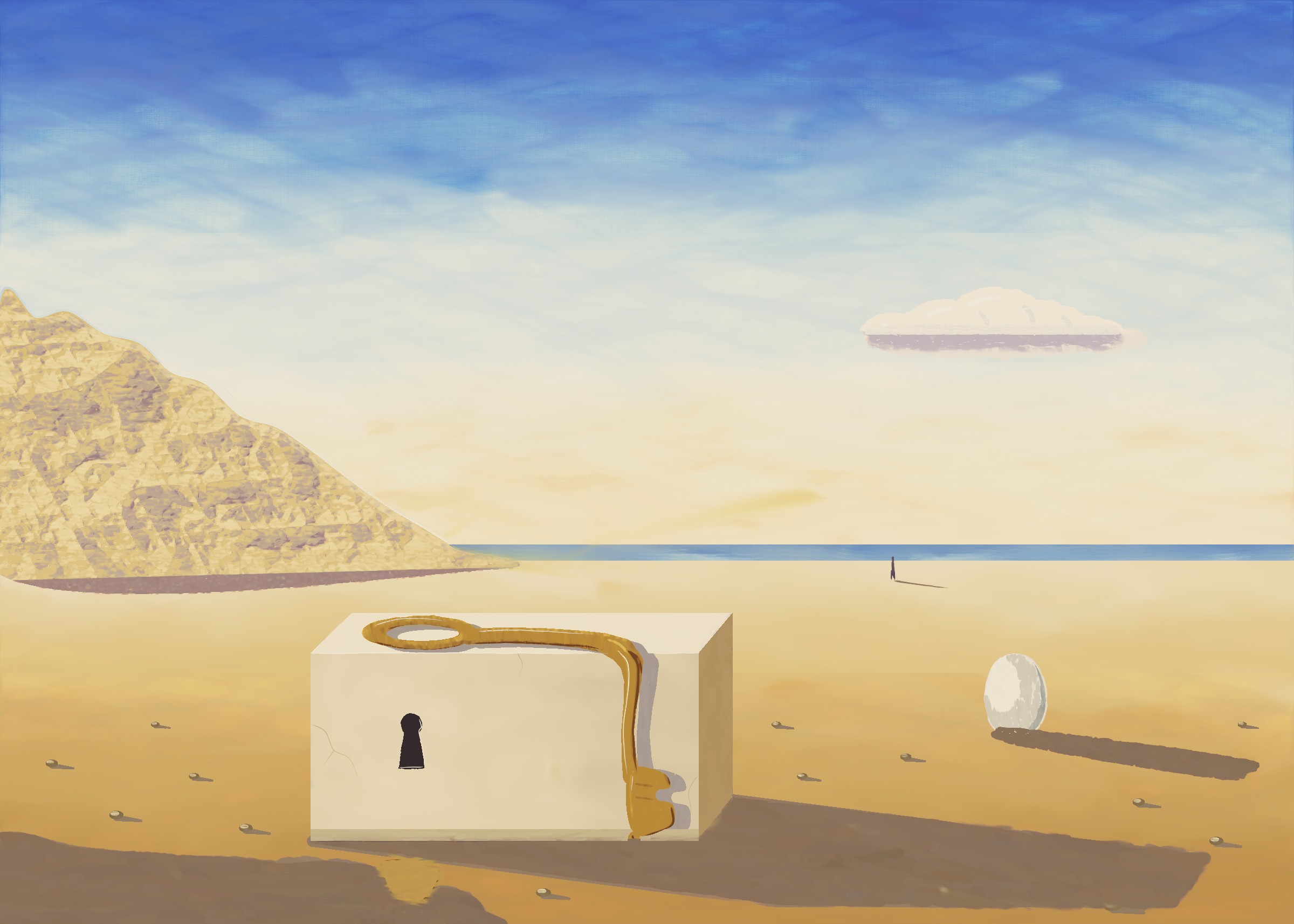
A pale stone block stands on an empty ochre plain at a low sun. A soft brass key lies on top of it and droops over the front edge like warm wax, with a drip hanging off the end of its bit. A few centimetres away on the block's face is a keyhole the key can never reach. The light comes in low from the left, so the block, an upright egg and a scatter of pebbles each throw a long violet shadow to the right. A dark band across the bottom-left foreground is the head-and-shoulders shadow of a figure who is never shown. Behind them, golden cliffs in the manner of Cap de Creus slope down to a thin blue line of sea. A tiny walker trails his own shadow along the shore, and a single cloud hangs in a sky that runs from deep cobalt at the top to lemon and rose at the horizon.
Two weak spots are still there: the cloud is flat-bottomed and a little schematic, and the egg doesn't turn much in the light. The key, the stillness of the plain and the small figure by the sea work well enough that I'd rather not risk them by repainting.
Watch it being painted, with its thinking →
What the painter was asked
Compose and paint one original picture in the manner of Salvador Dalí, at the easel, a simulator of oil paint on linen. The subject and composition are yours to invent. Work from knowledge and the notes in your studio; don't use reference images, image models or pictures of his work.
The painter's journal
- day 1, 09:00: Plan: "The Key to an Empty House". Canvas 400mm, aspect 1.4 (H≈714). Low horizon y≈430. Sky cobalt-ultramarine at top grading to pale lemon/rose at horizon. Left: golden Cap de Creus cliffs descending to the horizon at x≈360; calm thin bay of sea to the right. Plain of ochre, lighter toward horizon. Left of centre a stone plinth (x 300–540, top ≈465–490, front face to ≈620). A soft brass key lies on the plinth's top and droops over the front edge like cloth, bit hanging. Low sun from the left: long violet shadows to the right. Right foreground: a single upright egg with its own long shadow. Far off: a tiny figure and its shadow. Method: white knifed ground, graphite drawing, sky then land in lean paint, blend; objects after the setting dries; glazes of shadow; zinc-white highlights last.
- day 3, 14:00: Day 1–3. Sky graded in four piles and blended horizontally: good, with wispy streaks that read as high cirrus. First plain was too orange and mottled (broad hand + blend makes blotches); repainted on day 3 with muted piles (cobalt violet in every ochre mix), filbert 12 long horizontal strokes, fill, and four blends — smooth now. Cliffs failed twice: noise-thresholded crevices looked like texture; spur wedges looked like stripes; boulder crescents looked like Swiss cheese. Next: let them dry and repaint from a terrain form{} so light and shadow come from a real shape.
- day 10, 19:15: Day 10. Key painted (keyparts2 helper: ribbon shank that thickens at the fold over the edge and thins as it stretches downward, a drooping bit, a drip at the bottom). Egg shading kept dissolving into wet white: lesson is to model only over dry paint, with opaque mixes that are genuinely dark (cobalt violet is too weak; it needs raw sienna, ultramarine and a little bone black). Ideas: a keyhole on the plinth's front face that the key can't reach (the "empty house"); a far small figure with a long shadow; a big shadow cast from off-canvas across the bottom-left foreground; deepen the zenith.
- day 16, 21:03: Lessons: (1) a clean blender over a thin fresh layer on dry paint lifts it off, and over a small mask it smears darks everywhere; model small forms in separate value steps over dry paint and don't blend. (2) blending inside a rect leaves seams at the rect's edges; a blurred mask (rect:blur(25)) gives seamless blending. (3) raw sienna + cobalt violet glaze goes olive. Lifting it while wet with blends left a veined, travertine-like face, which I'll keep and warm later with a pale scumble.
- day 55, 02:53: Day 55. Finished. Final passes: shadows repainted opaque in one warmer mix (gsh2), which is cleaner than the streaky glaze; pebbles with little cast shadows; the unseen figure's head-and-shoulders shadow worked into a dark foreground band; a shadowed foot for the cliff; a warm glaze in the lower sky, blended through a blurred mask into faint sunset streaks. Weak spots I'm leaving: the cloud is flat-bottomed and a little schematic, and the egg's turning is modest. What works: the key's gleam and droop over the edge toward a keyhole it can't reach, the empty plain, and the tiny walker by the sea.