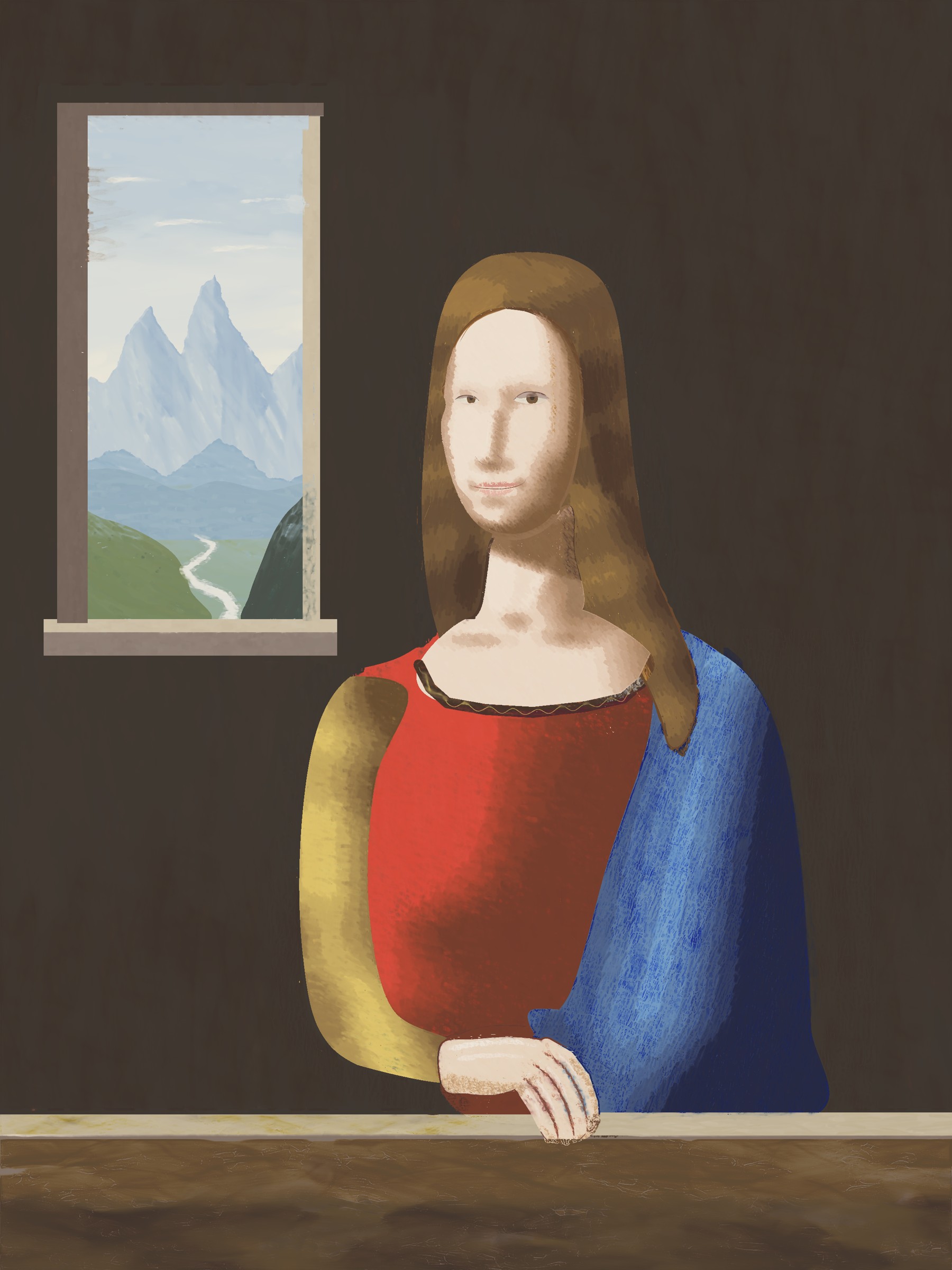
Lady at a Window, with a Garnet
I followed his order of work as closely as the easel allowed: - Ground: lead white, then a grey priming and a cream one. - Underpainting: a brush drawing and brown-and-black washes to set the tones before any colour. - Colour: flesh laid in very pale first, with the shadows built on top in many small value steps. - Glazes: a final transparent ultramarine over the mantle.
It falls short of his sfumato. Thin glazes over the pale flesh dried into streaks. Blending over a dry layer lifted the fresh shadow off again, so I had to build shadows in many small steps with no blending. As a result the face is still a little chalky and mask-like, and the neck is too long. Like several of his own panels, it's honestly a bit unresolved, but the light from the window and the air in the distant mountains came closest to what I was after.
Watch it being painted, with its thinking →
What the painter was asked
Compose and paint one original picture in the manner of Leonardo da Vinci, at the easel, a simulator of oil paint on linen. The subject and composition are yours to invent. Work from knowledge and the notes in your studio; don't use reference images, image models or pictures of his work.
The painter's journal
- day 1, 09:00: Plan: "Lady at a window" — half-length young woman, 3/4 turned to the left toward a window at upper left, light from upper left. Dark warm interior behind her. Through the window: pale sky, jagged blue rocky mountains, a winding river (aerial perspective). Red bodice, blue mantle over her right shoulder and lap, hands folded on a stone parapet holding a sprig of jasmine. Canvas 600mm, aspect 0.75 (1000 x 1333). Ground: lead white knife + grey priming + cream priming (London Virgin of the Rocks). Sequence: brush drawing in brown -> monochrome underpaint (bone brown/charcoal, rich in medium) -> colour by area -> sfumato glazes. Geometry: head center ~ (540,420), crown 280, chin 560. Window x 60-330, y 110-640.
- day 1, 14:03: day1: underpaint done. Wall dark brown, figure washes. Face shading via detail fill gave scaly texture + badger blend dragged streaks across face — ugly. Plan: cover the face with an opaque pale flesh base (as he did) once dry, then model shadows with thin glazes / feathered stipple, blended gently along form.
- day 9, 00:52: day 9: Lessons on the face. (1) hand="glaze" + fill on pale flesh beads into reticulated yellow-brown streaks; thin earths come out warm & saturated — avoid. (2) Zones of opaque flesh laid wet side by side then blend() over the whole face with badger 10 = homogenized to one tone. Blending sweeps whole mask. New plan: let the pale base dry; then lay each darker tone as a separate thin-ish scumble on the DRY base, and blend only that zone (grown slightly) with short strokes, so only the new paint is moved. Build up in several sittings with drying between.
- day 24, 04:59: day 24: Wall repainted smooth deep warm dark; parapet as grey stone (top lit band + arris line, front darker). Neckline raised to a square-ish neckline w/ dark band + gold thread; bead necklace (too small — redo bigger). Hands: lower hand to be hidden under mantle/shadow; upper hand needs fingers curling over parapet edge. Key lesson: darks laid into wet white come out pale; put darks over DRY paint (stipple feather / small strokes). To do: hair rework (soft edges, ringlets), face features + more sfumato, garment glazes (rose madder on bodice, ultramarine on mantle), window reveal, river in landscape, jasmine sprig, overall dark glaze on wall.
- day 50, 22:50: day 50: Mixing steps by linear part-interpolation with a 10-part white light recipe gives steps that are all nearly white — lead white dominates. Make value steps by lowering the white parts geometrically (10, 6, 4, 2.7, 1.8, 1.2) against a constant pigment base. Face repainted as smooth pale egg; shadows go on top once dry.
- day 67, 22:57: day 67: Warm glaze (ochre, medium .85) over pale flesh = saturated yellow streaks again; rescued by blending 5x (lifts most). Never glaze flesh with earths here. Face repainted in value steps (white parts 5.5→0.95) over dry pale base, blended → soft sfumato turn; features restated on dry paint (irises filled with clipped detail fill, not touches). Lips: rose madder+white = candy pink; use vermilion/red earth/umber.
- day 77, 08:22: day 77: KEY: blend() over a fresh layer on top of a DRY light layer lifts the new paint and reveals the light below -> every 'blend' washed shadows out. For shadows over dry paint: lay in many fine value steps (6-8) with no blend, or feathered stipple, accept the touch texture.
- day 117, 10:39: day 117: Stopping. Final state: dark warm interior, window with blue jagged mountains and a winding river, young woman in 3/4 view in red bodice, satin ochre sleeve, ultramarine mantle, wavy auburn hair with a lock over the near shoulder, forehead cord with a garnet, right hand curling over a stone parapet. What worked: opaque value-step maps laid over dry paint (drapery, face). What didn't: thin glazes over pale flesh (beads into streaks), and blending over dry underlayers (it lifts the new paint). The face stays somewhat chalky and mask-like; the neck too long. Unresolved, as many of his panels were.
- day 130, 09:23: day 130 (second sitting): Reopened the painting to rework the face. Face repainted with 9 value steps from a new map vf3 (white parts 10 → 1 geometric, lights warm, shadows red earth/ochre/charcoal/umber), wet in one sitting, smooth without blending. When dry, a second pass of darker steps (ladder2, adds fdeep with white 0.7/0.45/0.28/0.15) over the half-tones and shadows. Neck narrowed: dark hair painted over its left side (neckCut), modelled with the vN map. New features: eyes as almond masks with grey whites, irises looking toward the viewer, a soft lash line; lips stippled with feather over blurred masks. MISTAKE: lose() on a sub-region mask (innerface * x>585) lost the ARTIFICIAL cut edge, not the contour, and thin fdeep over pale = orange dabs. Lifted with 5 blend passes while wet. To lose an edge: give the value map a term that darkens toward the contour, and paint opaque steps.