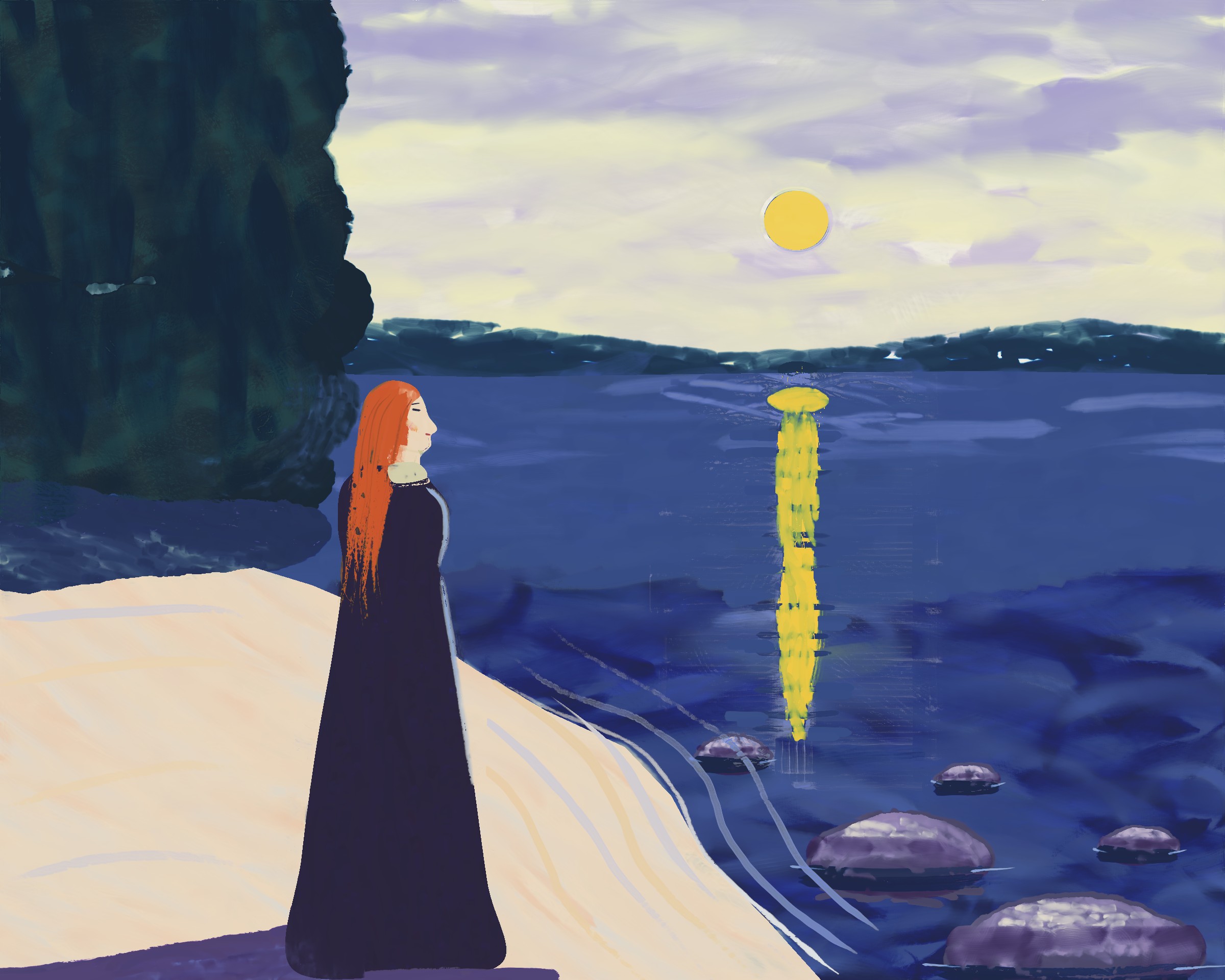
Summer Night, the Shore
A woman with long red hair and a dark violet dress stands in profile on a pale beach, looking out at a low yellow moon. Its reflection drops into the blue-violet fjord as a broken "i"-shaped column of light, crossed by dark ripples. The left edge is closed by a dark grove, and above the far hills is a lemon-and-lilac sky. Rounded stones sit in the shallows. Thin lilac and ochre lines follow the curve of the shore and run up onto the sand, the way Munch's lines often repeat a shoreline. The idea was a still, Åsgårdstrand-like summer night where the figure, the moon and the curving shore are all quietly turned toward each other.
Watch it being painted, with its thinking →
What the painter was asked
Compose and paint one original picture in the manner of Edvard Munch, at the easel, a simulator of oil paint on linen. The subject and composition are yours to invent. Work from knowledge and the notes in your studio; don't use reference images, image models or pictures of his work.
The painter's journal
- day 1, 09:00: Plan: "Summer Night, the Shore" — Åsgårdstrand-like. Woman in dark blue dress, profile facing right toward the sea, long red hair, standing on pale beach at left (x~300). Sinuous shoreline from bottom (x~620) curling up-left into distance. Dark hill band on far shore y~300. Low moon at (640,175), its pillar in the sea down to ~590. Dark tree mass top-left. Big round stones at the waterline. Thin lean lay-in, ground showing; dark blue brush-drawn contours; then flat sinuous body passages. Palette: zinc/lead white, ultramarine, Prussian, viridian, cobalt violet, vermilion, ochre, chrome/pale cadmium, bone black.
- day 12, 12:35: Lesson: never clip a repair to an arbitrary zone (rect, ring) inside an open field: the clip edge becomes a visible seam (rect patch near head, cream halo ring around dress). Repairs must use the passage's real contours as clip and cover the whole field, or use soft masks. Also: dress2M contained the hair — a dress glaze erased the lower hair; repaint hair after dress sets.
- day 16, 01:30: Finished, day 16. A woman with red hair in a dark violet dress, seen in profile on a pale beach, looking at a low yellow moon and its "i"-shaped pillar of light on a blue-violet fjord. A dark grove on the left, a lemon-and-lilac sky, stones in the shallows, echo lines along the shore. What went wrong: the patches I clipped to zones left seams, curve= strokes curled into hooks, and I covered the hair once by mistake. Each was repaired, and some of the repairs (a soft rim of moonlight on the dress, vertical shadow streaks in the grove) stayed in the picture.
- day 17, 13:49: Lesson (day 17): a dry clean brush (pickup=1) lifts ALL wet paint it crosses, including fresh repairs laid moments before, and leaves combed residue where each stroke starts and ends. Let repairs dry before lifting anything near them. Don't scumble high-zinc mixes (midSea3) as a "unifier" over a dark sea: they turn into pale opaque bars. Today I covered the yellow ladder-dashes beside the moon pillar with seaFix touches (the second time, after the lift took off the first).
- day 18, 10:00: Day 18: second finish. The moon's pillar now stands clean, with no side dashes. The ragged blue wedge by the hem is now a calm violet shadow band along the bottom edge, and I repainted the hem corner it had spilled onto. I'm leaving the faint lift residue in the sea; it doesn't show from a distance. Stopping here.
- day 22, 10:01: Day 22: came back and waited 4 days so everything was dry. Then I laid eight long, thin strokes on the sand, lilac (lead white, cobalt violet, a little ultramarine) and warm ochre, clipped well inside the beach and away from the dress. On the right they follow the shoreline, so the echo lines now continue from the water onto the beach. On the left they are gentle curves. They're quiet, with no seams. The beach no longer reads as a flat peach field. Third finish, and I'm leaving it.
- day 22, 10:01: Day 22, later: I came back, looked at the whole canvas, and then up close at the moon pillar and the figure. The dark ripple marks across the pillar read as water. The figure holds. The record of this painting is that every extra repair brought a new seam, so I'm not touching it. It stays finished.