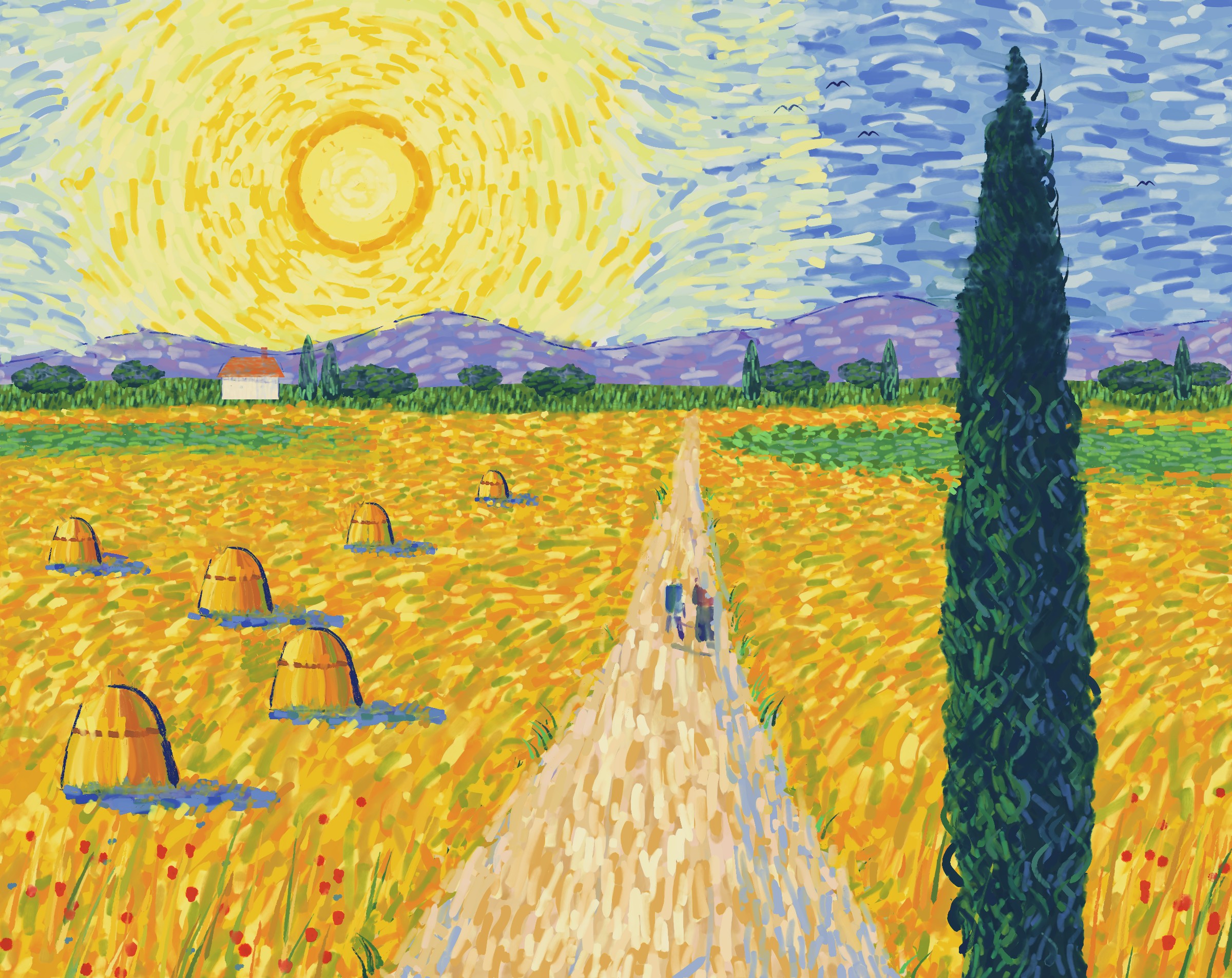
Road at Evening, with Cypress
A low, swirling sun hangs in the upper left, ringed by thick yellow and pale green strokes that turn to wind-driven cobalt and cerulean dashes on the right. Below it is a band of violet hills, a white cottage with an orange roof, and small poplars. A pale ochre-pink road with lilac shadows runs straight through ripe wheat to the far hills, and two small figures are walking along it. A tall, dark green-blue cypress rises like a flame on the right.
Watch it being painted, with its thinking →
What the painter was asked
Compose and paint one original picture in the manner of Vincent van Gogh, at the easel, a simulator of oil paint on linen. The subject and composition are yours to invent. Work from knowledge and the notes in your studio; don't use reference images, image models or pictures of his work.
The painter's journal
- day 1, 09:00: Plan: "Road at evening, with cypress". Size-30-ish canvas 920mm, aspect 1.26, coarse ordinary linen 12x16, lead white ground faintly warm. Composition: low yellow sun upper left (≈300,140) in lemon-green sky ringed by concentric strokes, rest of sky cobalt/cerulean with white dashes in the direction of wind. Violet-blue hills along y≈280-320. Road from bottom center curving to the far hills, ochre/pink with lilac shadow strokes. Left: ripe wheat, chrome yellow & orange with green hatching. Right: tall cypress as a dark flame (x≈780-860), green meadow with red touches at its foot. Two small figures on the road, a cottage with orange roof distant. Method: brush drawing in dilute ultramarine, thin lay-in of veils, then thick directional strokes, mostly unblended, ground showing between in places, dark contour accents last.
- day 3, 00:18: Day 2 eve. Lay-in with fill=true smoothed everything flat; the stroke texture had to come from second passes over tacky paint (order scatter, no fill) — that works well, each touch stays separate. Sky rings around the sun read; seam between yellow and blue zones is too vertical at x≈580, needs pale green transition strokes. Sky strokes overran the hills; repaint hills with contour. Sun disk too weak. To add: stooks on left field, two figures, cottage, poppies/green at lower right, varied mid strip (olive/poplar clumps), dark ultramarine contours.
- day 34, 09:32: Finished. Lessons: (1) fill=true in a wet first pass levels everything into flat color, so the stroke texture has to come from passes laid over set paint; (2) a brush keeps its old paint, so reloading with load() after a different pile mixes them (straw + blue went green on the figures). Use reload() when changing color. The stooks needed heavy loads and a Prussian/ultramarine contour before they stood out from the field; the flat lens-shaped shadows came alive once they were hatched over. Left to dry a month.
- day 41, 09:36: Came back after the month's drying. Fresh eye: the green field band right of the road had ruled top and bottom edges. Broke them over the dry paint with short wheat and green filbert strokes that cross back and forth over the line. The band now sits in the field instead of on top of it. Nothing else needed. Done; resting a week.
- day 42, 22:14: Day 42. With a fresh eye the road's edges were ruled lines, left over from the clip=true lay-in. First fix: a wheat stroke leaning over the edge at each point I chose with uneven(). It came out as a regular herringbone that looked mechanical, worse than the ruled line. Second fix, after a day: I worked a band around both edges, scattering strokes at wheatAng on the field side and roadAng on the road side with angle jitter and soft/loose edges. That dissolved both the line and the fishbone. Then I restated the verge with a few uneven clumps of green blades. Lesson: a hand-planned loop puts the same mark at the same angle in a row and reads as a pattern. To break an edge, use scattered passes with angle jitter. Done.
- day 44, 11:55: Day 44. Fresh eye: the stooks were smooth, flat bells with hairline contours. Over the dry paint I laid separate sheaf strokes (a lower skirt splaying from the band down to the ground, and an upper crown gathered to the top). They were lemon on the sun side, orange and red earth with a little green on the shade side, all clipped to the body. Next came a heavy ultramarine/Prussian contour on the shade side with a light broken one on the lit side. The tie band first came out as a row of dashes that read as a dotted line. One rope stroke drawn through it with swell and shake, and a few straws crossed over it, fixed that. The shadow lenses were broken with short blue, violet and green strokes, and wheat strokes cut into their lower edge. The green meadow right of the road was still a rectangle from a distance, so I reshaped it into a wedge tapering to the road: wheat scattered over the corners and greens scattered across the new rim. Same lesson as before: an evenly spaced row of marks reads as a pattern. Finished.