Claude Monet
Monet's mature oils are on plain-weave linen bought ready primed, mostly in the standard French sizes. Until about 1881 the grounds are often tinted (warm gray, pinkish beige, buff, light brown); from the mid-1880s they are nearly always one off-white layer of lead white and chalk. He drew little on the canvas. He covered the whole canvas roughly first "to determine at the outset the tonality of the whole," then built it up in touches, wet-in-wet within a session and wet over dry across sessions. He used tube paint, often straight from the tube, and no glazes.
The paint box
Painted here
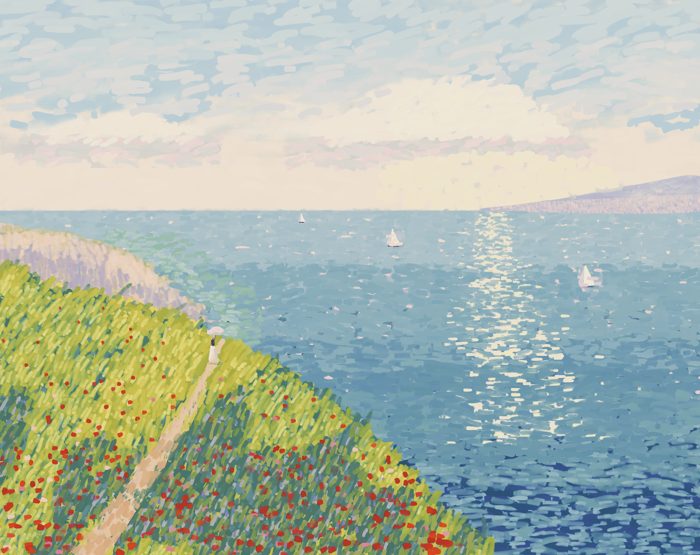
Poppies on the Cliff Path, Morning Sun
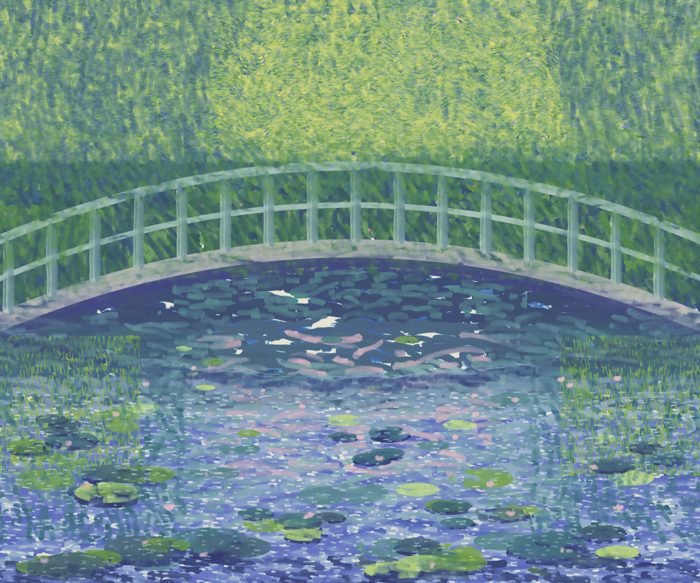
The Footbridge over the Lily Pond
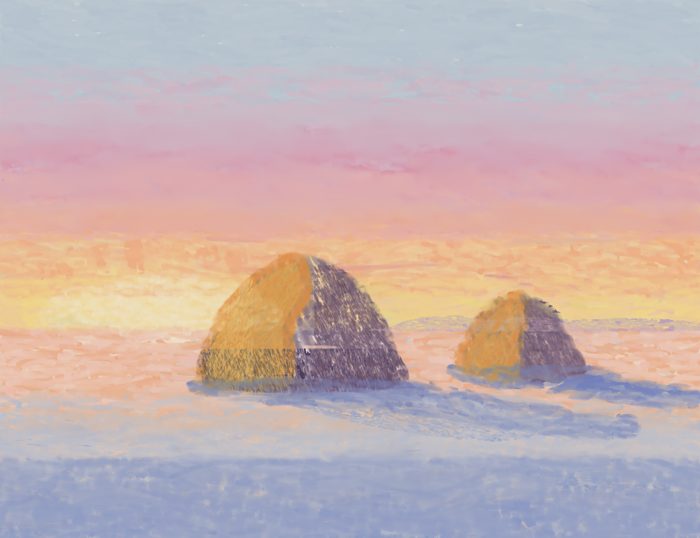
Meules, soleil couchant, hiver
Materials and method
A sourced technical report. Every claim cites a source key; the sources are listed at the end. "Uncertain" marks claims that are unverified, disputed or taken from a single object. The evidence comes mainly from the technical reports of an online museum catalogue covering about thirty oils of 1867–1919, two technical articles from a national gallery (a river scene of 1869; two studio canvases of about 1914–17) and the recollections of an American painter who summered next door to him from 1889 to 1909. These were read in full. His 1905 list of colors, his colorman's list and a dealer's note of his palette (1918) were read through their quotation in one article. The gallery's 1990 book on Impressionist technique was read only through full-text search excerpts and a pigment database's summaries, which supply its page numbers. The account of his eyesight was read through an encyclopedia summary.
Summary
Monet's mature oils are on plain-weave linen bought ready primed, mostly in the standard French sizes [AIC; AIM excerpt]. Until about 1881 the grounds are often tinted (warm gray, pinkish beige, buff, light brown); from the mid-1880s they are nearly always one off-white layer of lead white and chalk [NGTB5 pp.22–23; AIC]. He drew little on the canvas [AIC cats. 17, 18, 21]. He covered the whole canvas roughly first "to determine at the outset the tonality of the whole," then built it up in touches, wet-in-wet within a session and wet over dry across sessions [AMA27 pp.120–121; AIC]. He used tube paint, often straight from the tube, and no glazes [NGTB5 pp.14–21]. In the 1860s–70s one color might hold seven or eight pigments; late, one or two with white [NGTB28]. Many canvases were reworked, signed and finished at the edges in the studio [AIC cats. 27–33, 38–41]. He disliked varnish; dealers varnished many pictures to sell them [AIM excerpt]. The late water-lily canvases are 2 m high, built in thick layers left to dry between campaigns, from a narrower palette of purer, stabler pigments [NGTB28]. §4 lists the pigments.
Terms. Ground/priming: the layers between canvas and paint. À grain / lisse: commercial canvas primed with one layer (keeps the weave texture) or two (smoother) [AIC, notes]. Standard size: the numbered French canvas sizes, each in three shapes: figure, landscape and marine. Tacking margin: the canvas folded over the stretcher's side. Reserve: an area left bare in the lay-in for later paint. Wet-in-wet: paint laid into wet paint. Wet over dry: a layer on dried paint. Impasto: thick, raised paint. Glaze: a transparent layer. Lake: a dye fixed on a white base, a transparent pigment. XRF: X-ray fluorescence, which finds elements but not dyes. SERS: a Raman method that can identify a dye. X-radiograph: an X-ray image, which shows lead-rich paint. IRR: infrared imaging of carbon drawing under paint. Cross-section: a microscopic sample cut through all layers.
1. Supports
- Linen, bought primed. Every canvas in the catalogue is plain-weave linen bought already primed [AIC cats. 13–47]. He "bought his canvas ready prepared" from a Paris colorman [AIM, excerpt]; Paris colormen's stamps survive on canvases of 1868–91 [AIC cats. 14, 15, 19, 21–26, 29]. Abroad he bought locally, in London and Venice [AIC cats. 39, 45].
- Sizes. Most are standard nos. 20, 25, 30 and 40, in all three shapes [AIC cats. 14–35]. The grainstacks of 1890–91 use four formats consistently: 60 × 100 cm, 65 × 100, 65 × 92 and 73 × 92 [AIC cats. 27–33]. From the later 1890s several are non-standard, "probably custom ordered" [AIC cats. 36, 41, 47].
- Weave. Average thread counts run from about 15 to 33 threads/cm, most between 19 and 28; the finest is the Venice canvas of 1908 [AIC]. Warp-thread matches show eight canvases of 1889–1900 cut from one bolt [AIC cats. 25, 34, 36, 37].
- Reused canvases. Four canvases (1881, 1890–91, two grainstacks) hold an earlier, unrelated composition, scraped down or covered with a white or light layer [AIC cats. 18, 26, 30, 31]. Unrelated impasto under the 1869 river scene suggests a reused canvas there too [NGTB5 pp.14–18]. Uncertain.
- Late canvases. The water-lily decorations were about 200 × 425 cm; he fixed 200 cm as the height for them and related pictures, which stood on wheeled easels in a roof-lit studio 23 × 12 m [NGTB28]. A report on another museum's late canvas suggests he cut canvas from a primed roll and stretched it himself [AIC cat. 46, note]. Read through that note only.
- Outdoors. He painted river series from a boat "fitted up with grooves to hold a number of canvases," and kept grooved boxes of canvases around the water garden [AMA27 pp.121–123].
2. Grounds
- Commercial. The ground runs to the edges of the tacking margins, so the canvas was cut from a larger primed piece, "probably commercially prepared" [AIC cats. 18, 30].
- Tinted before about 1881. A Boston survey found that all of that museum's Monets dated before 1881 have colored priming, "usually of light brown, pinkish grey or off-white" [NGTB5 pp.22–23, citing it]. Examples: light warm gray under warm pinkish beige, 20–140 µm thick (1867) [AIC cat. 13]; warm pale gray (1870) [AIM, excerpt]; a "thin mauvish coloured ground" of lead white with traces of black and red ochre (1872) [AIM pp.142–147]; warm gray (1873) [AIC cat. 15]; light brown with iron oxides including burnt umber (1881) [AIC cat. 18].
- A tint over a stock canvas. A snow scene of about 1878–81 has a greyish-buff ground in two layers. Only the lower, greyish-white one reaches the turnover edges, so the tinted layer was added after stretching, by Monet or by the colorman at his request [AIM, excerpt].
- White and off-white. The 1869 river scene is on a white ground of lead white with a little barium sulfate [NGTB5 pp.22–23]. Cream or off-white grounds appear from 1877 [AIC cats. 16, 17, 19]. From the mid-1880s nearly every ground is one off-white layer of lead white and chalk with traces of bone black and iron oxide [AIC cats. 21–37], one measured at 10–80 µm [AIC cat. 31].
- Late. One water-lily canvas has a single layer of lead white. A canvas of 1914–17 has two; the upper is cooler, perhaps leaner, and stops short of the edges, so he may have added it himself [NGTB28]. Grounds of 1906 and 1908 are strongly brush-marked, and the texture shows through the paint [AIC cats. 44, 45].
- Ground left showing. Most canvases leave flecks of ground bare between strokes, most of all at edges and corners [AIC]. The 1869 river scene is almost wholly covered [NGTB5 pp.19–21].
3. Drawing and lay-in
- Little drawing. Charcoal particles that seem to belong to a drawing lie along table edges (1880), masts and rigging (1881) and a shoreline and cliff edge (1885) [AIC cats. 17, 18, 21]; in 1881 IRR showed nothing and the particles were seen only under the microscope [AIC cat. 18].
- Cover the canvas first. "The first painting should cover as much of the canvas as possible, no matter how roughly, so as to determine at the outset the tonality of the whole." He showed a canvas painted once, "covered with strokes about an inch apart and a quarter of an inch thick, out to the very edge," and one painted twice, where "the strokes were nearer together and the subject began to emerge more clearly" [AMA27 pp.120–121].
- Thin, dull lay-ins with reserves. In 1877 a station roof was blocked in with very thin dull browns, purples and grays; the steam and the skylight went straight onto the reserved ground [AIC cat. 16]. In 1889 thin toning layers went with long impasted strokes rich in lead white [AIC cat. 25]. In 1900 thin washes of deep red, brown and green "map out the composition and provide the general tone" [AIC cat. 37]. Grainstacks start from subdued tones or a light underpainting [AIC cats. 28, 29].
- Late. The first layers of a late water-lily canvas are more mixed, broader and less pastose than the surface [NGTB28]. At the edges of a canvas of 1914–17 they are thin opaque washes apparently thinned with solvent; a palette knife was used in early layers [AIC cat. 46].
4. Pigments
In 1905 he listed "blanc d'argent, jaune cadmium, vermillon, garance foncée, bleu de cobalt, vert émeraude et c'est tout" (lead white, cadmium yellow, vermilion, deep madder, cobalt blue and viridian, "vert émeraude" being French for viridian), adding that one could do "even more luminous and better with another palette" [NGTB28]. His colorman recalled selling him lead white, light cobalt violet, viridian, fine ultramarine, vermilion "sometimes, rarely," "a trinity of cadmium yellows: light, dark, lemon" and lately an "outremer jaune citron," probably a barium or zinc chromate [NGTB28]. A dealer saw on his palette in 1918 cobalt, ultramarine, violet, vermilion, ochre, orange, two greens, yellow ochre and "jaune d'outremer" around "mountains of white" [NGTB28].
| Pigment | Evidence | Notes |
|---|---|---|
| Lead white ("blanc d'argent") | Every analysis [NGTB5 pp.22–23; NGTB28; AIC]; his 1905 list | "The only white pigment of any importance" he used [NGTB28] |
| Zinc white | 1873, 1890–91, 1897 [AIC cats. 15, 31, 36]; "possibly" 1908 [AIC cat. 45] | Minor; also in restorers' retouching [AIC cats. 32, 43] |
| Bone or ivory black | 1867–81 [AIC cats. 13–18]; 1869–77 [AIM pp.120–131, 142–147, 166–171] | After 1881 only "possible" traces [AIC cats. 25, 35] |
| Chrome yellow | 1869 [NGTB5 pp.22–23]; most canvases 1867–1906 [AIC cats. 13–44] | He later blamed "a dreadful chrome yellow" [NGTB28] |
| Lemon yellow: barium, zinc or strontium chromate | Barium, 1869 [NGTB5 pp.22–23]; zinc/barium, late [NGTB28]; zinc, 1914–19 [AIC cats. 46, 47]; strontium, 1900–01 and 1908 [AIC cats. 41, 45] | Barium yellow "tends to lack brightness and covering power" [NGTB5 pp.22–23] |
| Naples yellow | 1873, in late touches [AIC cat. 15] | Single object |
| Cadmium yellow | From 1873 [AIC cats. 15, 16]; c.1878–81 [AIM pp.182–187]; nearly every later canvas [AIC; NGTB28]; 1905 list | Light, dark and lemon grades [NGTB28] |
| Cadmium orange | Late [NGTB28; AIC cats. 46, 47] | |
| Yellow ochre / iron oxide yellow | 1867–77 [AIC cats. 13–16; AIM pp.126–131, 142–147]; on his palette in 1918 [NGTB28] | None in the two late canvases analysed in London [NGTB28] |
| Red ochre / iron oxide red | 1867–72 [AIC cats. 13, 14; AIM pp.126–131, 142–147] | |
| Burnt sienna | 1867, 1868, 1900–01 [AIC cats. 13, 14, 41] | |
| Vermilion | Every period [NGTB5; NGTB28; AIC]; 1905 list | Late, "rarely" [NGTB28] |
| Red lake (madder; once carmine) | Red lake "throughout" most canvases by UV [AIC]; madder 1900 and 1914–17 [AIC cats. 37, 46; NGTB28]; "garance foncée," 1905 | Carmine once, in a still life of 1880 [AIC cat. 17] |
| Prussian blue | 1869, dark costumes and a ready-made green [NGTB5 pp.22–23] | Single object |
| Cobalt blue | Nearly every canvas [NGTB5; NGTB28; AIC; AIM]; 1905 list | |
| Synthetic ultramarine | Most canvases from 1868 [AIC cats. 14–47; AIM pp.182–187; NGTB28] | Not in the 1869 river scene [NGTB5 pp.22–23] |
| Cerulean blue | 1873, 1908 [AIC cats. 15, 45]; 1877 [AIM pp.166–171] | |
| Viridian | Every period [NGTB5; NGTB28; AIC]; 1905 list | |
| Emerald green | 1869 [NGTB5 pp.22–23]; most canvases 1867–1901 [AIC cats. 13–40] | Given up as unstable [NGTB28] |
| "Chrome green" | 1869: chrome yellow coated with Prussian blue [NGTB5 pp.22–23] | A ready-made mixture |
| Cobalt violet | 1869, by microscopy [NGTB5 pp.22–23]; most canvases from 1897 [AIC cats. 35–47; NGTB28] | Late, the light (arsenate) kind [AIC cats. 44, 45] |
| Malachite | 1906, 1908 [AIC cats. 44, 45] | Two late canvases only |
- Mixtures. In the 1860s–70s "some colours and tints [consist] of up to seven or eight distinct pigments" [NGTB28]; a dull gray roof of 1885 mixes several bright pigments [AIC cat. 23]. About 1878–81 he made violets from cobalt blue and red lake [NGTB28]. Late, "single pigments, or perhaps just two pigments together, often mixed also with lead white" [NGTB28].
- Stability. The late palette matches the permanent pigments recommended by handbooks of the day; cadmium and non-lead chromate yellows took over from chrome yellow [NGTB28], which still appears in 1906 [AIC cat. 44].
- Not found. Cadmium red: "no reports" of his using it [NGTB28 n.41]. Cobalt green: "not known" [NGTB28 n.28].
5. Media and varnish
- Tube paint. In 1869 the colors came "straight from the tube or hastily mixed on the palette" [NGTB5 pp.14–18].
- Oils. Samples of 1869 gave a ratio between poppy and walnut oil [NGTB5 pp.22–23]. In late canvases the colors are in poppy oil and one white in linseed [NGTB28]. A table in the 1990 book lists poppy, linseed and walnut oil for his pictures of the 1870s [AIM, excerpt]. Uncertain (rows not matched to pictures).
- Added medium. Some passages of 1890–91 are fluid enough that he seems to have added medium to the tube paint [AIC cats. 26, 27]; others are "dry, stiff, paste-like" [AIC cat. 30].
- Dry, matte paint. The late canvases look "dry, desiccated," but analysis shows no lean paint and no sign that he blotted out the oil, "as he is sometimes said to have done" [NGTB28]. A never-varnished canvas of 1914–17 is "dry, matte" with "localized strokes of glossy, more medium-rich paint" [AIC cat. 46].
- Varnish. He "was reluctant to varnish his paintings, but many were varnished by dealers in order to sell them"; his dealer reportedly told him that "collectors find your canvases too plastery" [AIM, excerpt]. Most of the catalogue's canvases have had later varnish removed [AIC]. On one of 1885 the signature lies over yellowed varnish and bridges cracks, so he signed it years later [AIC cat. 22].
6. Layers and application
- No glazes. "Monet used neither toning glazes nor glazes of a single colour. The most striking colour effects are obtained by the use of a single colour applied thickly" [NGTB5 pp.19–21].
- Opaque layers. In 1869 "three or four layers of paint may be superimposed," finished by "a final opaque layer," partly wet-in-wet [NGTB5 pp.22–23].
- Touches. Later canvases are built from separate strokes, often wet-in-wet "but with little mixing or blending" [AIC cat. 25], several colors often taken up on the brush unmixed [AIC cats. 18, 47]. Final touches are "lightly dragged across the surface," catching the texture below [AIC cats. 18–20, 27, 42].
- Brushes. Stroke widths point to flat brushes of about 0.2–2 cm, most often 0.5–1.5 cm; late, 1–3 cm [AIC cats. 13–47]. Critics likened his surfaces to woolwork because he dragged the color on "with the long flexible brushes he had made to order" [AMA27 pp.121–122; AIM, excerpt].
- Thickness. A cathedral canvas kept boxed looked "like one of those embossed maps of Switzerland" [AMA27 pp.121–122]. A water-lily canvas of 1906 shows nine layers in one place [AIC cat. 44].
- Scraping and wiping. He scraped or wiped into soft paint to bring up colors from below, and once incised lines [AIC cats. 35, 40, 45].
- Late method. Each area was "left to dry or to dry partially, before another layer was applied"; the thickest impasto lies over partly dried paint, and broken surface strokes let the underpainting show [NGTB28]. His late palette had "a great mound of white" in the middle [NGTB28].
7. Working sequence and reworking
- On the motif. In 1869 he painted over boats that had moved, leaving "ghost images" [NGTB5 pp.14–18]. He held that "no painter could paint more than one half hour on any outdoor effect," and from his boat worked "sixteen or more canvases one after the other for a few minutes at a time" [AMA27 pp.121–123].
- Slowness and the studio. "I'm becoming so slow in my work that it makes me despair" (October 1890); the grainstacks were worked "partially en plein air, partially in his studio" [AIC cats. 27–33]. In London in 1901: "it is not possible to work on the same paintings two days in succession"; he would finish them "at my leisure in the studio," and showed them only in 1904 [AIC cats. 38–41].
- Several sessions. Wet-in-wet and wet-over-dry passages together show more than one session [AIC cats. 19, 23, 26, 44]. A London canvas was reworked after "the earlier paint layers had had sufficient time to dry" [AIC cat. 41]. Late, he worked several large canvases at once [NGTB28].
- Changes. Figures, boats and stacks were moved or painted out [AIC cats. 14, 21, 22, 28, 29]; in 1917–19 lilies went in both before and after the reflections [AIC cat. 47].
- Edges and signatures last. His stepson said that "in the studio, [Monet] signed his pictures and painted the edges of his canvases which he tended not to paint right up to their margins" [AIC cats. 27–33, 38–41, quoting a published study].
- Destroying work. About 1907–08 he "burnt up over thirty canvases" in one morning [AMA27 p.119]. Date inferred.
- Others' changes. A beige sky and a tinted glaze on the 1869 picture were later additions, removed [NGTB5 pp.19–21]; brushwork over the estate stamp of a canvas of 1914–17 dates from after his death [AIC cat. 46].
8. Condition and aging
- Impasto settles. He thought thick paint flattened with time: a cathedral canvas hung for two or three years "had so smoothed down" beside the boxed one [AMA27 pp.121–122]. His own account.
- Cracks and cleavage. Dark paint has drying cracks [AIC cat. 18]; where he scraped or wiped into soft paint, layers now separate [AIC cats. 35, 40].
- Fading. Red lake in reworked parts of a London canvas has faded, except under the frame [AIC cat. 41]. Zinc yellow can turn greenish-gray, and cadmium yellows "are not always stable" [NGTB28].
- Varnish and lining. Later varnishes yellowed and were mostly removed; lining has flattened some impasto [AIC].
- Eyesight. He had cataract from about 1912–14 and an operation in 1923, then destroyed some earlier canvases and from 1925 retouched others with bluer water lilies [GRU]. Uncertain (encyclopedia summary).
9. The tubes here
The historical names in this note are mapped to these tubes: lead white ("blanc d'argent") → lead white; zinc white → zinc white; ivory or bone black → bone black; chrome yellow → chrome yellow; barium, zinc and strontium chromate yellows ("outremer jaune citron") → zinc yellow (one tube for the lead-free chromate yellows); Naples yellow → Naples yellow (one canvas); cadmium yellow → cadmium yellow; the light and lemon cadmium grades → pale cadmium; the dark cadmium grade and cadmium orange → deep cadmium (a proxy for the orange); yellow ochre and iron oxide yellow → yellow ochre; red ochre and iron oxide red → red earth; burnt sienna → burnt sienna; vermilion → vermilion; red lake, madder and "garance foncée" → rose madder; Prussian blue → Prussian blue (one canvas); "chrome green" → Prussian blue and chrome yellow (mixed on the palette); cobalt blue → cobalt blue; synthetic ultramarine → ultramarine blue; cerulean blue → cerulean blue; viridian ("vert émeraude") → viridian; copper aceto-arsenite → emerald green; cobalt violet → cobalt violet. Malachite and carmine have no tube here (§4).
10. At this easel
- Support. Plain-weave linen with ground layers laid from the tubes.
- Paint. Pigment from the tubes with an oil-medium share.
- Taking paint off. A brush picks up wet paint as it passes; that is how paint comes off the canvas.
- Everything else the easel does is in the easel guide.
Sources
- [AIC] Art Institute of Chicago, Monet Paintings and Drawings at the Art Institute of Chicago (online catalogue, 2014; revised digital edition 2026), https://doi.org/10.53269/9780865592698 . Entries by G. Groom and others; technical reports by K. Muir, analyses by I. Fiedler, F. Pozzi and others. Cited by catalogue number: 13 (1867), 14 (1868), 15 (1873), 16 (1877), 17 (1880), 18 (1881), 19 (1882), 20 (1884), 21–23 (1885), 24 (1886), 25 (1889), 26 (1890–91), 27–33 (grainstack series, 1890–91), 34 (1895), 35–36 (1897), 37 (1900), 38–41 (London series, 1899–1904; 41 dated 1900–01), 42–43 (1901), 44 (1906), 45 (1908), 46 (1914–17), 47 (1917–19). "[AIC]" alone: a pattern across entries. The stepson's words are quoted there from J. House, Monet: Nature into Art (1986), p.171. Read in full. https://www.artic.edu/digital-publications/48/monet-paintings-and-drawings-at-the-art-institute-of-chicago-2
- [NGTB5] Wilson, M., Wyld, M. and Roy, A., "Monet's 'Bathers at La Grenouillère'," National Gallery Technical Bulletin 5 (1981), pp.14–25: history (pp.14–18), cleaning (pp.19–21), pigments (pp.22–23); section pages from the article's own cross-references. Read in full (text version). https://www.nationalgallery.org.uk/research/research-resources/technical-bulletin/technical-bulletin-volume-5
- [NGTB28] Roy, A., "Monet's Palette in the Twentieth Century: 'Water-Lilies' and 'Irises'," National Gallery Technical Bulletin 28 (2007), pp.58–68. Quotes his letter of 3 June 1905 (translated in R. Kendall, Monet by Himself, 1989, p.196), his colorman's list as recorded by a critic, a dealer's diary of November 1918 and a conversation of 1920. Read in full (text version); internal pages not recovered. https://www.nationalgallery.org.uk/research/research-resources/technical-bulletin/technical-bulletin-volume-28
- [AIM] Bomford, D. et al., Art in the Making: Impressionism (London: National Gallery, 1990). Pages 120–125 (1869), 126–131 (1870), 142–147 (1872), 166–171 (1877) and 182–187 (c.1878–81) from the ColourLex summaries, https://colourlex.com/project/resources-claude-monet/ . "Excerpt": read only through Internet Archive full-text search excerpts, page not recovered. https://archive.org/details/impressionism0000unse_z3w3
- [AMA27] "Reminiscences of Claude Monet from 1889 to 1909," The American Magazine of Art 18:3 (March 1927), pp.119–125, by an American painter who spent ten summers next door to him (not named here under the studio naming rule). Page numbers approximate (read from an OCR scan). Read in full. https://archive.org/details/american-magazine-of-art_1927-03_18_3
- [GRU] Gruener, A., "The effect of cataracts and cataract surgery on Claude Monet," British Journal of General Practice (May 2015). Read only through the English Wikipedia article on him. https://en.wikipedia.org/wiki/Claude_Monet