Old Woman Reading
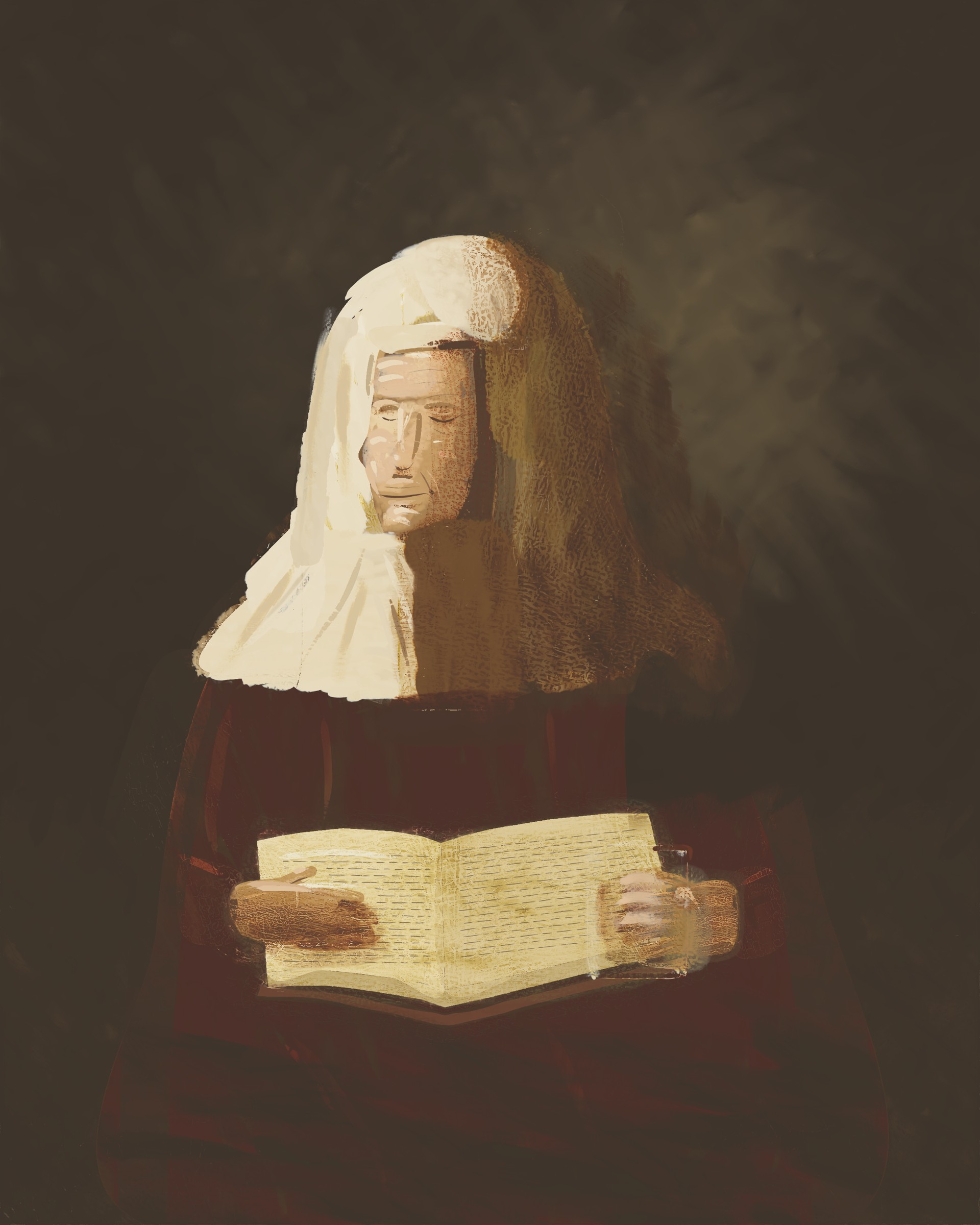
An old woman sits bent over a large open book. Light from the upper left falls on her white headcloth and the near side of her face, and on the pages. Everything else sinks into a warm brown dark with a faint glow behind her shoulder. The cloak is a crimson-brown that's lost at the edges.
What changed this session: - Hood: its shadow side is now a deep russet that dissolves into the background on the right. Before, it was a flat ochre bell, the same size as the lit side and almost as bright. - Face: it now has a shadowed far side, and the lit planes (forehead, cheekbone, nose and chin) have stiffer, lighter paint. - Crown: it turns from light into shadow. - Book: the pages are toned like old paper, so the text marks no longer look typed. - Hands: each has a lit back and a shaded underside.
Watch it being painted, with its thinking →
What the painter was asked
Compose and paint one original picture in the manner of Rembrandt van Rijn, at the easel, a simulator of oil paint on linen. The subject and composition are yours to invent. Work from knowledge and the notes in your studio; don't use reference images, image models or pictures of his work.
The painter's journal
- day 1, 09:00: Plan: "Old woman reading" — late manner. Canvas 700mm, 4:5, drab quartz-clay-like ground (whiting/umber/ochre/charcoal over red-lead-white). Head at ~(440,420) in white headcloth, bowed to the left/down toward a big open book at lower centre-left (~y 820-1000), hands on it. Light from upper left. Cloak dark red-brown. Background dark, a warm glow on right behind the shadowed side of head. Sequence: brown sketch (Cassel/umber) -> dead colour darks thin, lights white-ochre -> work up background, then figure, head, book, hands -> glazes, final impasto.
- day 2, 12:58: Lesson: blend() and work() on a crisp mask leave a crisp boundary (blend lifts paint inside and stops at the edge). A glow needs edge="lost", soft masks, strokes radiating across the boundary — never a disc mask with a threshold.
- day 13, 05:55: Day 13: face shadow scumble came out as heavy opaque blobs (soften + filbert overrun at this scale), blending spread it over the whole face. Accepting it as a brown underlayer (Rembrandt's flesh-over-brown approach): let it dry, then build lights opaquely on top, leaving brown in shadows. At face scale (face ~130 units wide) use small rounds 2-3 wide, single strokes, no soften on tiny masks.
- day 21, 10:03: Lesson 2: blend() over a whole wet mass homogenizes it to one tone (lights win). Working method that works here: lay a body layer, let it set (tacky, ~1 day for lead white), then lay shadows as medium-rich glazes/scumbles and blend only the glaze; the set paint underneath stays. Lights then go on top as stiff paint, not blended.
- day 43, 03:08: Day 43: background repaint came out a mid olive — far too light (the umber/ochre/white mix reads lighter than expected over dark, and blending lifts). Plan: let dry and glaze dark (Cassel+bone black+umber, medium ~0.55), heavier away from the head, lighter right of head. Glazes here are strong: one glaze pass at medium 0.55-0.65 darkens a lot.
- day 47, 04:59: Day 47: hand="scumble" with pile fsw[2] even at load 0.35 covered the face opaquely and erased features. Recovered by lifting the wet layer with wiped flat brushes (many passes) — the dry layer below came back. Rule: on the face, only single deliberate strokes/touches, never area passes.
- day 60, 06:21: Day 60: stopping. The picture holds as a whole: the head-cloth and collar are lit from the upper left against a warm dark ground, the book is the second light, and a crimson-brown cloak is lost into the dark at the edges. Weak points I'm leaving: the hands are summary and a little wooden; the face still sits a bit like a mask in the hood opening; the background brushing is busier than it should be. What I learned at this easel: area passes (scumble, blend) over a whole wet passage flatten it. Value bands from a form scaffold laid over set paint, then single strokes for features, worked best. A glaze over dry paint can be lifted off with wiped brushes if it goes wrong.
- day 69, 03:28: Day 69 (session 2): Came back to fix the hood's shadow side (it had been a crackly olive texture). Repainted it opaque (white/umber/brown ochre), then a Cassel/yellow lake/red earth glaze, blended: it now reads as warm shadowed linen. Put a dark (umber/black/red earth/Cassel, NO white) band in the hood opening beside the face, laid on DRY paint. Lessons: (1) even 0.35 parts white in a dark mix turns it mauve-grey; darks must have no white. (2) dark into wet light paint just greys; wait till dry. (3) wiping with clip=rect leaves rectangular ghosts: clip to soft organic masks. (4) a ribbon for 'halo' removal must stop where the contour turns (it ran onto the cape).
- day 85, 07:00: Day 85: After several patchy failures around the head top (blob patches, halos, striped wipes), repainted the WHOLE upper background as one wet layer: broad hand with darkmix (Cassel 1, bone black .6, raw umber .5) clipped to -figure, glowW worked in with radial load_at right of head, then two crossing blend() passes over the whole region. Result: soft dark atmosphere with a glow — the best background so far. Lesson: background fixes must be whole-passage, wet, to the canvas edges, never local patches. Opaque raw umber reads mid-olive here; darkness comes from Cassel/black. Also: check the figure mask includes every flare of the costume (it cut off the cape; lifted the wet dark back off with 10 wiping passes clipped to the cape).
- day 107, 08:10: Day 100: Stopping (second session). Changes this session: background repainted wet as one passage, so the head sits in a dark atmosphere with a warm glow to the right; the hood is now a whole bell shape with a lit crown and a russet shadow side; the shadow at the far side of the face and jaw is set. Hands: a shadow glaze and cast shadows on the pages; the right hand ended as a soft, summary hand in shadow after a failed attempt at drawing the fingers (a 'comb' I lifted off). Lessons: shape masks for small forms (fingers) give flat cut-outs, so use single strokes over set paint instead. Wiping with rect clips leaves rectangular ghosts. Blending a glaze inside a mask that overlaps a neighbour drags the glaze into it.
- day 117, 10:46: Day 117 (session 3): Glazed the hood's shadow side darker (Cassel/red earth/black/umber, med .6, load heavier to the right) + 2 blends: it's now a russet-brown shadow instead of flat ochre. Failures: (1) blended thin half-tone over dark = cool bluish haze; (2) a yellow-lake glaze went mustard; (3) work(hand=body, fill, clip=crisp mask) = flat opaque cut-out lozenges AGAIN. All lifted with wiped flats (8-12 passes, soft organic clip). Rule, again: NO area passes inside small crisp masks. For transitions, draw single strokes that follow the form.
- day 141, 14:04: Day 141: Face: shadow glaze (Cassel/red earth/madder) on far side, lifted 2 passes to cut redness, blended terminator; lights as single stiff strokes then small blends to merge forehead. Book pages: thin umber/ochre/Cassel glaze, blended 4x -> aged parchment, typed dashes subdued. Crown saga: the grey turning was fixed by opaque strokes + blend, which made a flat 'egg'. Bringing cream wet-in-wet over its lit part merged it with the cloth; then a graded hglz glaze (wiped band to soften the left edge) and a STIPPLE of shbrown along the rim dissolved the egg outline into the hood's mottle. Lessons: yellow ochre/umber glazes over grey go olive-mustard; a glaze stroke along a contour traces it (don't); stipple is good for breaking an unwanted edge into texture.
- day 149, 14:30: Day 149: Stopping (third session). This session: the hood's shadow side went from flat ochre to a russet shadow that dissolves into the dark at the right (two graded glazes, blended); the face has a shadow side and stiff lights on forehead/cheek/nose/chin; the grey strip under the chin is now part of the shadowed drape; the crown turns from light into shadow; the book pages are toned like old paper; the hands have lit backs and shaded undersides. Squinted, the picture reads as one chiaroscuro: headcloth > book > face > hands in a warm dark. Still weak: features drawn as lines, the crown still a little knob-like, hands summary. Lesson of the session: every repair that was an area pass inside a small crisp mask failed; graded glazes over dry paint, single strokes, and stipple to break edges worked.